Oilers’ winning 4 out of 5 ain’t bad . . . but is it good?
The Associated Press
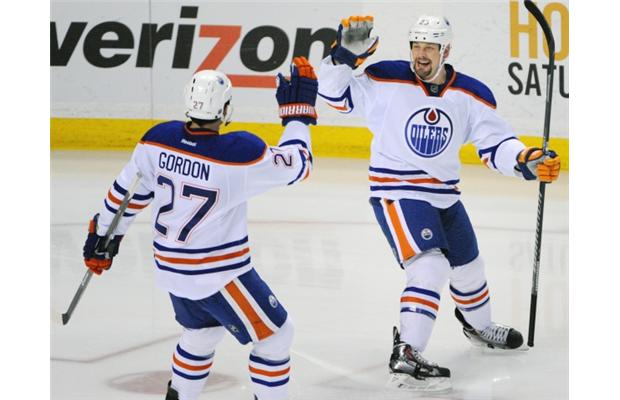
Edmonton Oilers forward Matt Hendricks, right, celebrates his go-ahead goal with linemate Boyd Gordon during third-period NHL action against the Buffalo Sabres on Monday in Buffalo. Hendricks’ goal, on a shorthanded breakaway, stood up as the winner in Edmonton’s 3-2 victory. The Oilers seem to be making strides, winning four of their last five games.
The Edmonton Oilers are on a roll — at least in terms of recent results.
They have won four of their last five games — including a stretch of three straight — for only the second time this season, on both fronts. The Oilers have yet to win four in a row or even five out of six, so they could raise their success bar with another victory Thursday night in New York against the host Rangers.
That would, all things considered, be a step in the right direction.
Yet, with the team stuck in second-to-last place overall and, by most estimations, mathematically out of playoff contention heading into the Olympic break, the fan base is struggling to get excited over these little (in the big picture) breakthroughs. And understandably so, having already come to grips with missing the post-season for an eighth straight spring.
Owner Daryl Katz attempted to sugarcoat that reality with last month’s sympathy letter but, reality is, patience and optimism are wearing thin in Oil Country.
Taking a closer look at the last five games won’t exactly rally the troops. Removing the copper-coloured glasses, it’s plain to see the Oilers aren’t making much in the way of forward progress — contrary to what those outcomes suggest.
Have they been playing better as of late? Sure. Kind of. I guess. But, by no means is that answer a resounding yes.
Expanding that window to eight games, which would encompass three consecutive one-goal losses, it’s impossible to argue that Edmonton isn’t making improvements and becoming more competitive on a nightly basis.
However, even with the win “streak”, this mirage hasn’t been all that impressive.
The Canadian Press
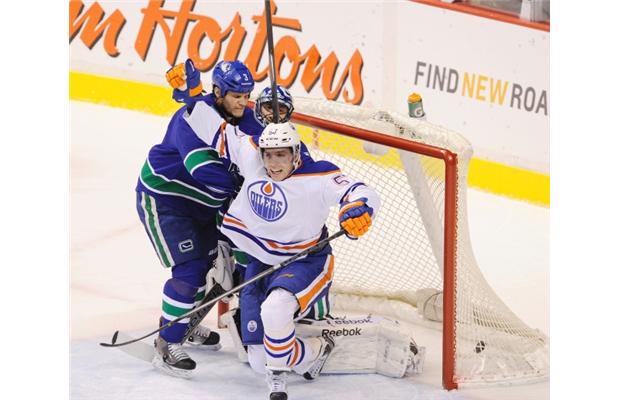
Edmonton Oilers forward David Perron celebrates his goal much to the chagrin of Vancouver Canucks defenceman Kevin Bieksa and goaltender Roberto Luongo during NHL action in Vancouver last Monday. Perron scored a hat trick and Edmonton prevailed 4-2.
Two of the victories were thanks to outstanding individual performances: David Perron’s second career hat trick and first as a member of the Oilers — ironically, both coming against the Vancouver Canucks — and newcomer Ben Scrivens’ NHL-record 59-save shutout in stonewalling the visiting San Jose Sharks.
From a “total team effort” standpoint, the best of the bunch was last Sunday’s 5-1 home win over the Nashville Predators. Edmonton was full marks for that one, but lest we forget, the Predators aren’t an upper-echelon team and their top goalie (Pekka Rinne) has been sidelined for most of the season with a hip infection.
The Oilers exposed his temporary placeholder Carter Hutton — who got the start ahead of Edmonton castoff Devan Dubnyk — and Dallas Eakins used last change to shelter the kid line from Shea Weber at times, which also helped matters.
That said, the Oilers were still outshot 35-27, so the scoreboard was a bit misleading in the end.
The same can be said for Edmonton escaping with a 4-2 road decision at Vancouver last Monday, which saw Perron dominate with three goals, including an empty-netter to seal the deal.
The Canucks outshot the Oilers by the same margin, 27-20, but experienced an emotional letdown coming off their dust-up with the Calgary Flames two nights earlier. This happened to be Vancouver’s first of what amounted to six games without the services of head coach John Tortorella (suspension) and captain Henrik Sedin (rib injury). And the Canucks were already reeling en route to finishing the month of January with a miserable 4-9-1-1 record. They continued to cling to the Western Conference’s final wild-card playoff spot following Tuesday’s action — just one point ahead of the Phoenix Coyotes, but still 19 clear of the lowly Oilers.
So give Edmonton credit for capitalizing on Vancouver’s misfortune in this contest, but don’t sing the praises too loud for squeaking out its first ‘W’ in three tries this season against a superior-but-slumping rival.
For those wondering, Perron previously turned the trick in a 6-1 thumping of the Canucks back on Nov. 10, 2009 during his third NHL season with the St. Louis Blues, who traded Perron to Edmonton this past summer in a 1-for-1 steal of a swap for Magnus Paajarvi.
Ed Kaiser/Edmonton Journal
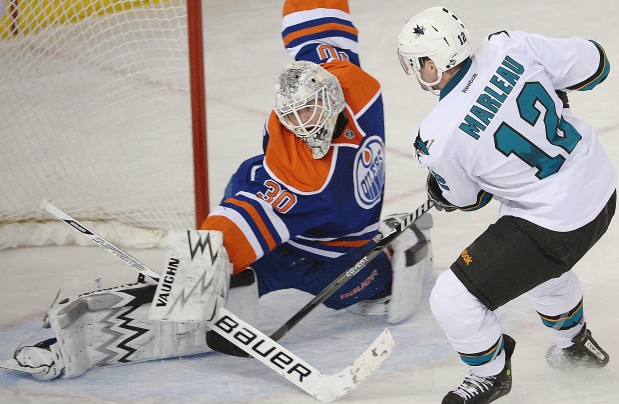
Edmonton Oilers goaltender Ben Scrivens makes a breakaway save on San Jose Sharks forward Patrick Marleau during NHL action at Rexall Place in Edmonton last Wednesday. Scrivens set a new NHL-record with a 59-save shutout in Edmonton’s 3-0 win.
Scrivens, who could prove to be rookie general manager Craig MacTavish’s other big coup, was acquired last month from the Los Angeles Kings for a token third-round pick in this June’s draft. The 27-year-old Spruce Grove product now has four shutouts on the season — tied for second among NHL leaders — but this was also a first for him as an Oiler. Not to mention a historic accomplishment.
The Oilers had no business beating the Sharks 3-0 that night. Granted, they were opportunistic in the offensive zone, but it should have been a 6-3 defeat at best if not for Scrivens’ heroics.
He followed that up with a 37-save showing in a 4-0 setback to the big, bad Boston Bruins in Beantown bright and early Saturday morning. Do the math and Scrivens stopped 96 of 100 shots in just two starts — yes, 96 per cent of the pucks he faced — which is certainly more of a credit to him than his teammates.
Even in Edmonton’s most recent triumph — if you can call it that — the Oilers were badly outshot, 44-28, but edged the host Buffalo Sabres 3-2 in a battle between the league’s two worst teams.
This wasn’t good hockey. It was sloppy and short on highlights. Edmonton’s power play, which has been Jekyll-and-Hyde all season, was as awful as ever — surrendering its league-high 10th shorthanded goal of the season in the process.
It was painful to watch in certain parts and almost resembled beer league at other moments, such as when Perron slid on his belly in a failed bid to get back onside or when Sabres netminder Jhonas Enroth grossly overplayed a breakaway move by Matt Hendricks that held up as the winning goal.
Not to take anything away from Hendricks, who has been another pleasant addition and brings a lot of what the Oilers were lacking in their bottom-six forwards, but he’s not a goal-scorer by trade. He’s never hit double-digits in a five-year NHL career to date, though he does have a few dangles up his sleeve and has been dubbed somewhat of a “shootout specialist” from his past stints in Washington and Nashville. But this was in regulation, off a shorthanded rush to be precise, so Enroth was left looking fairly foolish or amateurish in the aftermath as Hendricks celebrated his second goal since joining the Oilers in exchange for Dubnyk on Jan. 15 — the same day Edmonton landed Scrivens from L.A.
Not to rain on the parade, but rewind Monday’s game to insert regular Sabres starter Ryan Miller between the pipes and, chances are, we’re singing a different tune — something to the effect of ‘three steps forward, two steps back’.
Instead, everything appears hunky-dory and we’re blasting the ballad ‘4 out of 5 ain’t bad’ — or was it 2 out of 3 ain’t bad?
Regardless, Edmonton again found a way to win and there is something to be said for that. At the end of the day, this mini-run has to be viewed in a positive light, that the Oilers are finding the win column — some way, somehow.
However, realistically speaking, don’t expect that trend to last much longer.
It must be reiterated that although Edmonton has won four of its last five, it has been outshot in all five — by as few as seven and as many as 32 for a stunning-or-shameful combined total of 82 (206-124). Therefore, my trusty calculator tells me the opposition has averaged — I repeat, averaged — 16.4 more shots on goal per game than the Oilers over that span.
To predict prolonged success with shot discrepancies like that would be, for lack of a better term, silly. Well, asinine, really.
The law of averages, the underworld of advanced stats and, last but not least, common sense all indicate this pendulum is bound to swing back in favour of the bad guys sooner than later.
Some will counter that the Toronto Maple Leafs have made a habit of winning despite consistently getting outshot. They will also be sure to remind us that Scrivens was a product of that environment just last season, before he was shipped off to Hollywood in the summer trade that brought Jonathan Bernier to Toronto. But rest assured, the Leafs are the exception — not the rule. And, historically, allowing opponents to run up the shot-clock is a recipe for disaster — not success.
Sean Rudyk/Getty Images
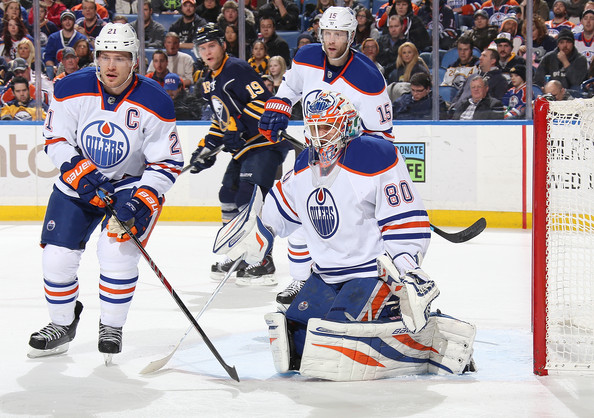
Edmonton Oilers goalie Ilya Bryzgalov braces for an incoming shot as teammates Andrew Ference, left, and Nick Schultz defend against Cody Hodgson and the Buffalo Sabres during NHL action in Buffalo on Monday. The Oilers won 3-2, thanks in large part to Bryzgalov’s 42 saves.
Ultimately, this statistical evidence speaks volumes about the quality of goaltending Edmonton has been getting from both Scrivens and Ilya Bryzgalov, who backstopped the victories over Vancouver and Buffalo.
If — or, inevitably, when — either of them slips up, Edmonton will probably be in for another serving of humble pie. That force-feeding could be on the menu as early as Thursday against the red-hot Rangers, who have won four straight and seven of their last 10.
The Oilers then have a quick turnaround to close out their pre-Olympic schedule with Friday’s stop in New Jersey to face the Devils.
Wish them luck — they might very well need it . . . again!
Oilers welcome another former Leaf, Mark Fraser, to fold
Richard Wolowicz/Getty Images
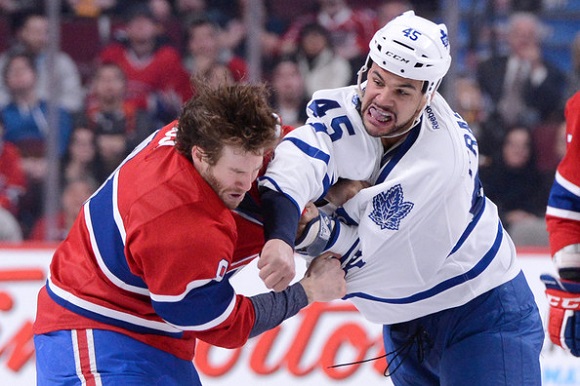
Former Toronto Maple Leafs defenceman Mark Fraser, right, tangles with Montreal Canadiens pugilist Brandon Prust during NHL action earlier this season. On Friday, Toronto traded Fraser to the Edmonton Oilers in exchange for forwards Teemu Hartikainen and Cameron Abney.
The Edmonton Oilers acquired Mark Fraser on Friday morning.
If your initial reaction to that trade with Toronto was ‘Mark who?’ ‘Fraser who?’ . . . fear not, you are not alone. Fraser is far from a household name at this point in his career, as a 27-year-old journeyman with only 162 NHL games on his resume over eight pro seasons to date.
All I really know is he’s big, he’s black (at least part black) and my girlfriend thought he was “kinda hot” when he fought Travis Moen of Montreal way back in the season opener on Oct. 1 . . . so he’s got that going for him.
Realistically, though, Fraser’s kind of a nobody.
But could he be a somebody? Maybe.
Fraser certainly brings a skill-set that Edmonton’s defence corps is currently lacking.
He’s big, as mentioned, listed at 6-foot-4 and 220 pounds.
The Oilers’ back end actually has decent size these days, but their most physical blue-liner is also their smallest in captain Andrew Ference at 5-foot-11, 187 pounds.
Anton Belov had been the biggest defender at 6-4 and 218, but the 27-year-old Russian rookie doesn’t strike fear into anybody or play an overly gritty game. Paired with Fraser, they could be an imposing tandem and Fraser’s feistiness could rub off. But neither are too fleet of foot, so that could also be a disaster waiting to happen. Truth be told, they might be auditioning against each other — together or apart — for a spot on next year’s depth chart.
Martin Marincin, another European rookie at just 21 years old, is also 6-4, but he’s a string bean at 188 pounds and relies more on positioning to keep attackers at bay.
Corey Potter is 6-3, 204 and probably the second-most physical behind Ference, but he’ll likely find himself on the outside looking in — both present and future — with Fraser’s addition.
Jeff Petry is 6-3, 195, but doesn’t go out of his way to throw bodychecks and I can’t remember the last time he dropped the gloves. If he ever has as an Oiler? . . . Hockeyfights.com to the rescue, reminding me that Petry has fought once — just once — against Matt Calvert of Columbus last March.
Fraser has 26 NHL scraps under his belt, according to Hockeyfights.com, including three this season. His most recent opponents: Moen, Brandon Prust also of Montreal and Dalton Prout of Columbus.
Nick Schultz, who tips the scales at 6-1 and 203, plays a shutdown style as a smaller, older Fraser, but Schultz is an unrestricted free agent after this season and most don’t expect him back. Fraser, who is making $1.275 million this season, is also a UFA, as is the aforementioned Belov, so there will be some healthy competition for playing time — present and future, again — amongst that trio.
Justin Schultz and Philip Larsen round out the nine defencemen on Edmonton’s roster, but those two don’t have a mean bone in their bodies. They are offensive puck-movers and point-producers, who won’t impact Fraser’s chances of sticking with the Oilers.
To that end, Fraser has mustered all of 17 career points, including only three goals, to go with his more-noteworthy 204 penalty minutes. This year, Fraser had tallied just one assist in 19 games, with 33 PIMs.
As for the deal itself, the price was right — cheap and fair. Edmonton gave Toronto the rights to Finnish forward Teemu Hartikainen, who bolted for the KHL this year and was essentially replaced by fellow Finn Jesse Joensuu. The Oilers also threw in an enforcer type in former Oil Kings forward Cameron Abney, who is a long-shot to step foot on NHL ice.
Worst-case scenario: Nothing lost, nothing gained.
Ideal result: Fraser proves serviceable as a bottom-pairing defenceman with a chip on his shoulder.
Absolute best-case scenario: A modern-day Charlie Huddy.
So, no, we didn’t just land the second-coming of Paul Coffey, or even Kevin Lowe.
But Fraser could be a bit piece to the puzzle going forward.
Nobody knows that potential answer better than Edmonton’s rookie bench boss Dallas Eakins — having coached Fraser for parts of two seasons with the AHL’s Toronto Marlies, and presumably having endorsed this deal much like he did in acquiring goaltender Ben Scrivens last month.
It should be cautioned, though, that being an effective AHL defenceman is entirely different than being an effective NHL defenceman. And Eakins’ scouting report on Fraser is from a minor-league perspective. Eakins, himself, is still getting his feet under him in the big league.
So time will tell whether there’s a long-term fit to be had here with Fraser. If not, there will be other UFA options and don’t forget Edmonton has a stacked cupboard in terms of defence prospects with first-round picks Oscar Klefbom and Darnell Nurse not far off — not to mention potentially adding Aaron Ekblad as a top-three pick this June.
Fraser won’t make-or-break this season or next, but he could make things more interesting and make life tougher on rival teams. Stay tuned . . .
Bernard Brault/La Presse
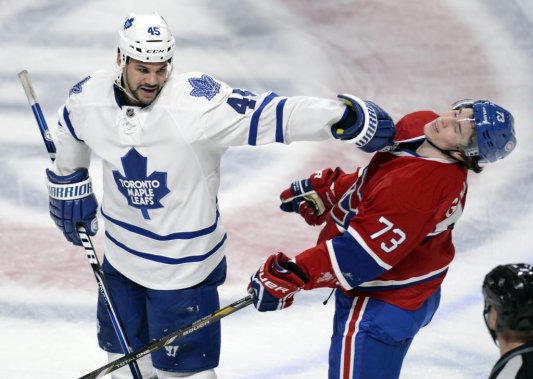
Fraser, who stands 6-foot-4 and weighs 220 pounds, delivers a stiff jab to the chops of 5-foot-9, 180-pound (soaking wet) Brendan Gallagher during their Original-Six matchup between Toronto and Montreal earlier this season. Fraser’s truculence, pugnacity and belligerence, among other traits, could boost Edmonton’s overall compete level and make the Battle of Alberta more entertaining with his former employer Brian Burke now the figurehead in Calgary. The Oilers and Flames next meet on Saturday, March 1 for a Hockey Night In Canada clash at Rexall Place in Edmonton.
Meanwhile, here’s my buddy Dan Nadeau’s short-but-sweet take on today’s trade. Thanks again for this contribution:
First off, let me say I don’t hate the trade, but I fail to see how it makes us better by adding another No. 4-6 D-man when we already have 5 of them.
We get toughness for sure, but I feel it’s in the wrong area. We need toughness on our top pair — you know, the guys who shut-down Corey Perry, Ryan Getzlaf, the (Sedin) Sisters and those types. We don’t necessarily need a guy to be tough against Paul Bissonnette-type players; we have Luke Gazdic, and Ryan Jones has proved he is willing to literally fight to stay in the NHL.
No, we didn’t give up a whole heck of a lot and people will say look at return on investment. But we are getting a D-man who averages 10-15 minutes of ice a night and is a minus-8 — that’s disturbing to me, especially coming from a Randy Carlyle-coached team!
I guess time will tell if I will eat my words. I really hope I do as a loyal Oiler fan, but hey, it could be worse, it could be another KHL “all-star” bust (see Belov).
In Ben, We Trust?

Graham James Holloway/Edmonton Oilers Fans (Facebook Group)
Edmonton Oilers goaltender Ben Scrivens put on quite the show Wednesday night, establishing a new NHL record with his 59-save shutout of the San Jose Sharks in a 3-0 win at Rexall Place. In case you missed it — or you just wanted to see it again to believe it — check out the link below. Either way, this will be seven minutes of your life you won’t want back.
http://www.youtube.com/watch?v=LxbPv5bR2fE
Ben Scrivens was nothing short of spectacular on Wednesday night. Some of the saves he was making were ‘cray, cray’ as the kids say these days.
When the final buzzer sounded, the newly acquired Edmonton Oilers goaltender had backstopped an NHL-record 59-save shutout — in a 3-0 blanking of the sharp-shooting San Jose Sharks, no less.
Scrivens was great, but can the Oilers expect greatness going forward?
The final 26 games of this year’s regular season should serve as a decent indicator of whether Scrivens warrants re-signing — as a starter, in a platoon scenario or as a hometown backup.
The Spruce Grove, Alta., product who turns 28 in September is a pending unrestricted free agent, having failed to establish himself as a starter in previous stints with Toronto and Los Angeles. He did show flashes with both franchises — albeit, not quite as flashy as Wednesday’s performance — but he was ultimately relegated to backup duty.
Personally, I’ve been familiar with Scrivens for some time. While working in Lloydminster for the Meridian Booster and covering the AJHL’s Blazers-turned-Bobcats, I first watched Scrivens play during his final junior season in 2005-06.
Even back then, I liked what I saw. As a teenager, Scrivens already had that “IT” factor and when he was on his game — in his zone — he was fully capable of stealing points for his team . . . as Oilers fans came to realize on Wednesday.
The AJHL has produced its fair share of NHL talents from that timeframe, including Mark Letestu (Bonnyville/Columbus), Justin Fontaine (Bonnyville/Minnesota), Matt Frattin (Fort Saskatchewan/Los Angeles) and Joe Colborne (Camrose/Calgary). None have developed into big-time scorers — at least not yet — but Scrivens faced them all in a standout campaign that saw him named Spruce Grove’s Most Valuable Player after also participating in the AJHL All-Star Game and playing a key role in Team North winning the 2006 Viking Cup in Camrose.
Scrivens finished that year with a .921 save percentage, which was a sign of things to come even as he took the road less travelled by going the NCAA route rather than playing major junior.
To that end, perhaps Scrivens was (or still is) a late bloomer, as goaltenders often are.
In four years of collegiate hockey with the Cornell Big Red, Scrivens’ save percentage gradually improved from .911 in 2006-07 to .934 in 2009-10. From there, he turned pro and has maintained a save percentage above .900 in climbing the ranks from the ECHL to the AHL to the NHL.
The next step? Solidifying a starting job in the NHL, an opportunity that very well could present itself in Edmonton next season. Based, of course, on how this season ends.
Because, as we all know, one game does not make a career. Not even if it is a career-defining game like the one Scrivens turned in on Wednesday.
In four starts since coming to Edmonton via trade from Los Angeles earlier this month, Scrivens has posted a 2-2 record, but he’s gradually been getting better as he’s settled into his new surroundings. That much is evidenced, again, by an escalating save percentage — going from .879 in his Oilers debut to .926, .971 and, most recently, a perfect 1.000.
There’s essentially nowhere to go but down from that flawless effort, but those numbers average out to .944 and if Scrivens could somehow sustain that kind of save percentage — or anything north of .925 — Edmonton would be crazy not to keep him around in some capacity. That’s assuming he isn’t demanding crazy dollars come summer, or whenever the two sides enter into contract negotiations.
Time will tell what the future holds for Scrivens in Edmonton — short-term and, potentially, long-term. I wouldn’t bet against him becoming the new face of the franchise between the pipes — that is, if he wants to continue calling Edmonton home past this season.
It would also be in the Oilers’ best interests, in my opinion, to find him an experienced goaltending partner that has been an NHL starter in the past. Depth and competition in the crease is never a bad thing, and so long as their roles are clearly defined from Day 1, that partner should only bring the best out of Scrivens and push him to thrive in his new environment.
Any of Martin Brodeur, Tim Thomas or Evgeni Nabokov would fit that bill via free agency. Or if the Oilers preferred a younger backup with the aforementioned platoon potential, then Brian Elliott, Jonas Gustavsson, Thomas Greiss, Anton Khudobin, Al Montoya or even Ray Emery are possible options.
I’m not a huge fan of the platoon blueprint for success, however. More often than not, it blows up in a bad way with a goaltending ‘controversy’ and neither guy ends up performing to their capabilities or the fan base’s expectations. The 1A and 1B concept presents an uncomfortable situation that Scrivens is already well-versed in, having battled James Reimer — and the Toronto media — for the Maple Leafs’ starting status. For everybody’s sake, I would hope Edmonton has learned from others’ mistakes.
I also hope the Oilers are aware of their own blunder in signing an older, sub-par goaltender as a backup, which they did by bringing in Devan Dubnyk’s buddy Jason LaBarbera this past summer. Chalk that up to a rookie error in judgement by MacT, but I see him steering clear of Tomas Vokoun, Jean-Sebastien Giguere, Scott Clemmensen and those types this time around.
If it’s determined that Scrivens is best suited as a backup or an understudy of sorts, then perhaps Ryan Miller, Jonas Hiller or Jaroslav Halak would be the best bets as free agents. Or, as my blog suggested yesterday, acquiring Cam Ward from Carolina via trade could be a great ‘buy low’ move — granted with a high cap hit, or comparable to what Miller, Hiller and Halak will command on the open market.
At the end of the day, there are clearly several options available to Edmonton in the goaltending department. But, for the time being, the ball is in Scrivens’ court and his play will likely dictate the next move or series of moves.
Rebuilding the rebuilt Oilers in 5 not-so-easy steps

QMI Agency
Edmonton Oilers general manager Craig MacTavish, left, and president of hockey operations Kevin Lowe (if still in the picture) have their work cut out for them in transforming the floundering franchise back into a Stanley Cup (or at least playoff) contender. That challenge might not be as daunting as pessimists persist, however, and could be accomplished with just a handful of moves, which I’m about to dictate and dissect in this blog post.
I think we, as Edmonton Oilers fans/followers, can agree that even in the midst of this two-game winning, umm, (streak?), this team needs an overhaul — again.
Yes, it’s time to rebuild the rebuild — at least to some extent.
So, where do we start? Or where should general manager Craig MacTavish be starting?
That’s debatable. Some would argue that championship teams are built from the crease out. Others would insist that defence wins championships. Then there are those who believe run-and-gun firewagon hockey from the Oilers’ heydays can enjoy a resurgence and we’ll simply “outscore” the opposition.
The latter approach clearly isn’t working this season. Either we don’t have enough offence. Or we’ve over-rated the offence we do have. Or the kids carrying the offence are, heaven forbid, still kids and not capable of dominating night in and night out. It’s most likely a combination of all those trains of thought.
Remember, Rome wasn’t built in a day. But for the sake of this blog — and the fact the Oilers have missed the playoffs for eight years running; 2,782 days since their last post-season game if we must do the math — we’re going to construct (or rather reconstruct) Edmonton’s roster in a matter of minutes.
In fact, we’re going to simplify it into 5 easy (or not-so-easy) steps.
A true do-it-yourself model.
Here goes nothing . . .
Step 1: Acquire Cam Ward
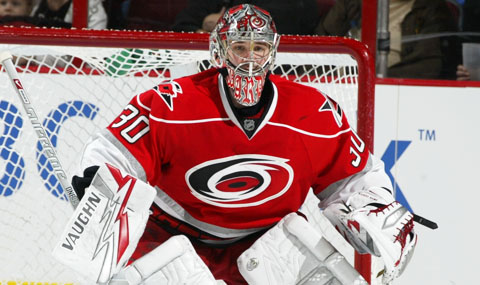
We need a proven starting goaltender and there might not be a better one available. That’s not to necessarily say Cam Ward is available, but I’m assuming he could be had considering his recent struggles and injury-proneness with Carolina and the Hurricanes’ relative success in his absence thanks to the tandem of Anton Khudobin and Justin Peters. If they believe in either of those goaltenders long-term, they may be willing to part with Ward and his $6.3-million cap hit, with two years remaining on this escalating contract that carries annual salaries of $6.7 million next year and $6.8 million for 2015-16.
Ward also comes with a Stanley Cup-winning pedigree, having hoisted hockey’s holy grail in 2006 after beating, ironically, the Oilers in a seven-game series. Ward was the biggest difference-maker back then — yes, even bigger than Fernando Pisani — but, lest we forget, that was 2,782 days ago and he hasn’t accomplished a whole heck of a lot in the 7 years, 7 months and 11 days since then in terms of winning hardware.
Further, Ward is from nearby Sherwood Park, Alta., a suburb of Edmonton, so it would be a homecoming for him and his young family. His wife is from Red Deer. Paired with Ben Scrivens of Spruce Grove, Alta., who would need to be re-signed (preferably at a hometown discount, $1.5 million per year let’s say), Edmonton’s goaltending woes could, finally, become a thing of the past.
This wouldn’t be a cheap risk, but it would be a “bold” move that could come with a very worthwhile reward. Of course, Ward would have to want to come home for this deal to come to fruition as the soon-to-be 30-year-old has a modified no-trade clause.
Assuming he’s willing to waive it, what would it take to get Ward? It depends if Carolina is pushing for a playoff spot at the March 5 trade deadline, with Ward still a non-factor in that push, then the ’Canes may want some “win-now” pieces. The Oilers have Sam Gagner and Ales Hemsky to possibly satisfy those needs as an upgrade, or as depth, on the wings. But more than likely, Carolina would want a defenceman to address their weakness (which also happens to be Edmonton’s current weakness). Jeff Petry fits that bill, as would have Ladislav Smid before he was dealt to the Calgary Flames for cap space (and peanuts).
Conversely, if Carolina trends downward over the next month and finds itself out of the post-season running, then maybe this deal is delayed until the NHL draft in June. At that point, Edmonton’s first-round pick (which will likely be top 3) becomes extremely attractive. Or perhaps even next year’s 2015 first-rounder instead if Edmonton has its eyes on a 2014 top prospect — cough, Aaron Ekblad, cough. The Oilers have plenty of defensive prospects they could part with in such a deal, including former first-rounder Oscar Klefbom, Dillon Simpson, David Musil, Martin Gernat or Joey Laleggia.
The deal: Edmonton acquires Cam Ward and a conditional 2nd-round pick in 2015 in exchange for Jeff Petry, David Musil and the Oilers’ 1st-round pick in 2015. The condition being that Ward starts more than 50 games for Edmonton in 2014-15; if he doesn’t, the Oilers get the pick.
Step 2: Acquire Tyler Myers
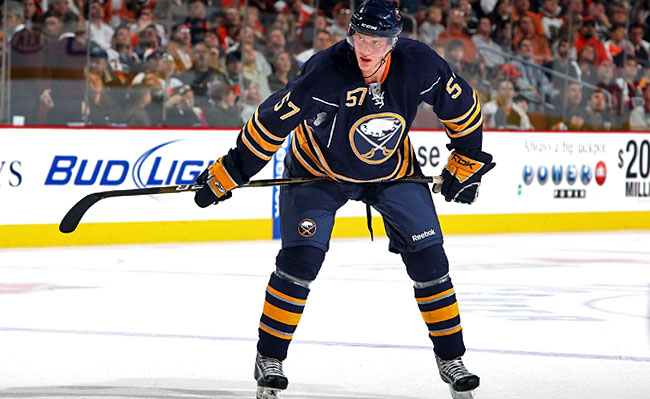
This step is a little trickier, especially since Myers seems to be improving since Ted Nolan took over the coaching reins. Myers is a monstrous defenceman — listed at 6-foot-8, 219 pounds (and gaining) — and the Oilers have had a heart-on for him since his draft year in 2008. They reportedly tried to trade up to get him before Buffalo took him 12th overall, with Edmonton settling for scoring winger Jordan Eberle at 22nd. Myers won the Calder Trophy in 2010, but Eberle has arguably had the more successful career to date. That said, defencemen tend to take longer to develop and the Oilers would still likely make that swap in a heartbeat if the opportunity presented itself.
Myers’ contract is also somewhat of a concern, with a $5.5-million cap hit through 2018-19, or for five more seasons. But it was frontloaded and actually declines steadily in annual salary from $5 million next year to $3 million in the final year. With the league’s salary cap expected to increase exponentially over the next few years, this concern really isn’t a concern at all. And Myers, who only turns 24 this weekend, could be a bargain by the end of his current contract. This could be a steal of a deal. Please, nobody tell the Sabres that.
Myers also has Alberta roots, having been raised in Calgary for his teenage years — his Texan father is employed in the oil and gas industry — so he might be warm on coming to Edmonton, not that it’s much worse climate-wise than Buffalo.
Make no mistake, though, Myers won’t come cheap. The Sabres and Oilers have a decent trading history, but Buffalo would want a scoring forward — and preferably one better than Linus Omark (insert link to evil laughter sound clip here). Eberle, who is the same age and has a similar contract ($6 million per, also through 2018-19), immediately comes to mind. But Eberle tends to be a complementary player, and Buffalo may want more of a game-breaker who is marketable to its fan base with the Sabres just starting their rebuild. Hmm, that sounds like Nail Yakupov would fit the bill as a recent first overall pick who played junior just over three hours away from Buffalo in Sarnia, Ont. This could be quite the match, with both teams meeting each other’s needs in a classic 1-for-1 swap. Buffalo already has a ton of top-end defence prospects, including a pair of towering 2013 first-rounders in Nikita Zadorov and Rasmus Ristolainen.
The deal: Edmonton acquires Tyler Myers for Nail Yakupov.
Step 3: Acquire Marc Staal
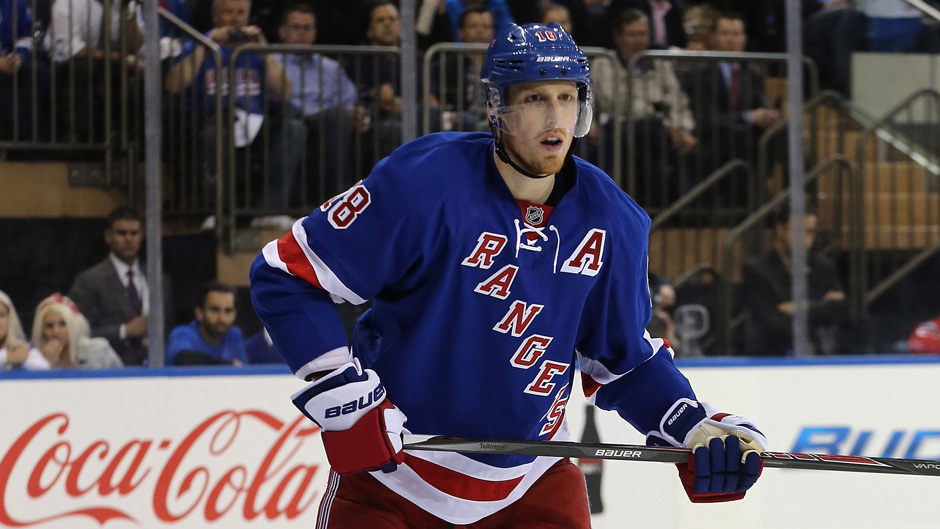
The New York Rangers are, strangely, struggling to sign both captain Ryan Callahan and shutdown defenceman Dan Girardi. It’s possible both deals get done before the aforementioned March 5 deadline, but if not, rumours are persisting that the Rangers would move one or both despite their obvious importance to that franchise’s Cup hopes. Part of that hesitation on signing Girardi could come from the fact the Rangers already have $3.975 million committed next year to Marc Staal, a similar-but-three-year-younger defender. If Staal came off the books, it’s likely the Rangers could afford Girardi at that price, though Girardi could command $5.5 million on the open market and will likely get paid one way or the other.
Not coincidentally, the Rangers also just traded for another stay-at-home defenceman in Kevin Klein from Nashville. That is now a strength for New York and one of Girardi or Staal would seem expendable. Here’s hoping it’s the latter.
There’s no guarantee Staal would stay in Edmonton past next season, with some speculation that he’d prefer to join brothers Eric and Jordan in Carolina. But one season, especially a winning one, could be enough to sell Marc Staal on becoming a long-term Oiler.
It’s worth the risk for several reasons, not the least of which is the fact Staal would make the perfect partner for Myers and give Edmonton a formidable top pairing for the first time in a long time.
If anybody is willing to take a chance on Ales Hemsky, my hunch is Glen Sather would be that guy. The Rangers’ GM has expressed past interest in the pending free agent, and Hemsky brings some of the skill-set New York lost in sending Marian Gaborik to Columbus. Hemsky could potentially click with Rick Nash and make the Rangers that much more dangerous in the playoffs. Plus, it’s very likely New York is on Hemsky’s wishlist for destinations as a UFA, so if he performs reasonably well, it’s entirely possible he could re-sign with the Rangers in the summer.
That said, Hemsky’s trade value does not equate to Marc Staal’s. The Oilers would need to add something, likely a defensive prospect — of which they have an abundance. I could see Slats wanting Dillon Simpson, the son of former Oilers forward-turned-broadcaster Craig Simpson.
The deal: Edmonton acquires Marc Staal for Ales Hemsky, Dillon Simpson and a 2015 fourth-round pick.

Step 4: Acquire Brandon Dubinsky
The Oilers need to get bigger up front, particularly in their top six. Dubinsky is a 6-foot-2, 216-pound centre that plays big and physical. He turns 28 in April and will be entering his ninth pro season next fall — that makes him an experienced veteran by hockey standards, entering what should be the prime of his career.
Can you tell where I’m going here? Yes, he’s the ideal replacement/upgrade for Sam Gagner on Edmonton’s second line. Gagner is three years younger and might have a higher offensive ceiling or be more talented with the puck, but Dubinsky appears, on paper, to be a better fit for the Oilers.
MacTavish has reportedly been scouting Columbus as of late, and Dubinsky has been on Edmonton’s trade radar in the past when he was with the Rangers. It’s also no secret that Gagner is being shopped ahead of March 5, with his no-trade clause kicking in this summer.
Gagner is in the first of a three-year contract with a cap hit of $4.8 million and an annual salary of $5 million for each of the next two seasons. Dubinsky, like Marc Staal, a former teammate of his, is signed through next year at a cap hit of $4.2 million with a salary of $4.65 million. He, too, would have to be sold on Edmonton going forward, but again it seems like the right kind of a gamble.
Gagner may not be enough to get this deal done straight up, but add in another forward with size who “could” have Dubinsky upside and Columbus probably pulls the trigger.
The deal: Edmonton acquires Brandon Dubinsky for Sam Gagner and Tyler Pitlick.

Step 5: Sign Thomas Vanek
Last but not least, the Oilers will need to replace Nail Yakupov, and to a lesser degree Ales Hemsky. Assuming Vanek doesn’t re-sign with the Islanders before March 5, or before July 1, he will be an unrestricted free agent — and a coveted one at that. The Islanders really want to keep him and he has found chemistry with John Tavares and Kyle Okposo, so this could be a mute point sooner than later.
If Vanek reaches the open market, expect Edmonton to be all-in . . . again. Don’t forget the Oilers already signed Vanek once, when he was a young emerging sniper in Buffalo, inking him to a seven-year offer sheet that is now expiring. The fact the Sabres matched that contract is probably a good thing for Edmonton’s sake as the salary figures were ahead of their time, but Vanek is now in his prime and worth every penny.
Vanek just turned 30 years old, so he’s another veteran and he has decent size, listed at six-feet, 217 pounds. He’s a finisher, having twice scored 40 goals on weaker Buffalo teams.
Vanek has a history with Myers and, as mentioned, he previously agreed to terms with the Oilers, so it makes sense that he’d be willing to come to Edmonton. A little known fact is that Vanek, who hails from Austria and will captain his country at next month’s Sochi Olympics, has already called Alberta home. He lived in Lacombe, less than an hour south of Edmonton, as a 14-year-old prodigy, dominating the AA midget ranks before moving on to the USHL in Sioux Falls, S.D., and later the University of Minnesota. Vanek is well versed in cold winters from all his hockey stops, so that shouldn’t scare him away.
Falling short of Vanek, then Gaborik, Devin Setoguchi or, dare I say, Dany Heatley could fill that void as a UFA signing.
The deal: Edmonton signs Thomas Vanek to a 5-year, $35-million contract.
In conclusion . . .
Simple as that, the Oilers are rebuilt (again) and ready to contend for the playoffs, much closer to a Stanley Cup parade than they are today.
Given all that, the Oilers would still have their first-round pick in June, and should be able to select either Aaron Ekblad or Sam Reinhart — both of whom could be ready to make the NHL jump next season.
Past that, the Oilers will also need to fill some depth roles, with 3 to 4 forwards and at least one defenceman. A couple of those holes will likely be filled from within, but there could also be free-agent options.
As a depth defenceman, I would like to see Edmonton sign Keith Aulie, who was paired with Myers in the 2009 world juniors but has yet to find a permanent NHL home. He’s big — listed at 6-foot-6, 228 pounds — and a shutdown type that could play alongside the emerging Martin Marincin in a sheltered third-pairing role. If not Aulie, then perhaps the 6-foot-4, 218-pound Anton Belov sticks around in that capacity.
At forward, I have penciled in Ryan Jones, Jesse Joensuu and Luke Gazdic as players who seem to have earned Dallas Eakins’ trust and admiration. Those three could be back, and, of course, Ryan Smyth might have another year left in the tank. But I think they could find a bigger, grittier and, most importantly, younger version of Smyth to play with Boyd Gordon and, presumably, Jones on a third line. Referencing capgeek.com’s list of UFAs, I’d like to add one or two of Nikolai Kulemin, Steve Downie, Blake Comeau and David Moss — in that order of preference.
If all those transactions came to pass, Edmonton fans could be welcoming this team to the ice in October:
Forward
Taylor Hall-Ryan Nugent-Hopkins-Jordan Eberle
David Perron-Brandon Dubinsky-Thomas Vanek
(Kulemin/ Downie/Comeau/Moss)-Boyd Gordon-(Ryan Jones)
(Jesse Joensuu)-Matt Hendricks-(Luke Gazdic)
Defence
Tyler Myers-Marc Staal
Andrew Ference-Justin Schultz
(Anton Belov/Keith Aulie)-Martin Marincin
Goal
Cam Ward
Ben Scrivens
Obviously, if Ekblad/Reinhart and-or 2013 first-round defence prospect Darnell Nurse force their way onto the roster, we would have to make room for them. But that’s a nice luxury to have, as opposed to forcing the issue and pressing youngsters into roles they aren’t yet ready for.
Long story short, the future is still bright in Edmonton and could become so much brighter with a handful of realistic moves between now and next season.
Your thoughts?
Firing squad missing mark in targeting Oilers’ Lowe
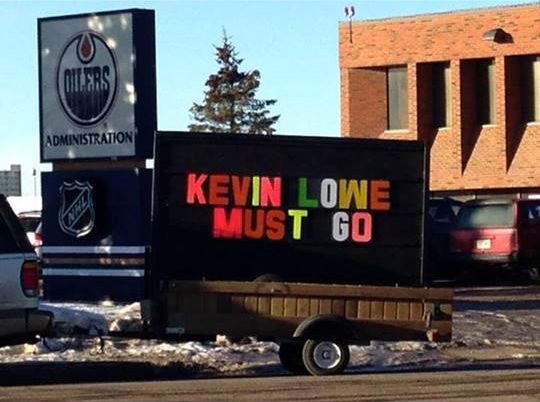

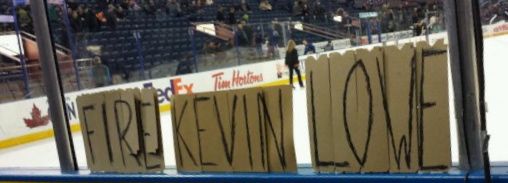
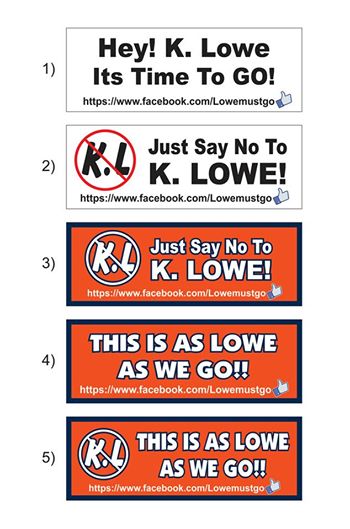
Kevin Lowe has to go? Does he really? Says who? . . . Not the boss, apparently.
There’s an ongoing Facebook and billboard signage campaign to oust the Edmonton Oilers’ president of hockey operations. The social media page ‘Kevin Lowe has to go’ has racked up more than 14,000 Likes from the NHL team’s loyal-turned-loathing fan base, and sports radio shows have been fueling that fire for weeks as well. Its momentum — or perhaps Lowe’s own conscience — prompted the five-time Stanley Cup winner to approach Oilers owner Daryl Katz offering to take a sabbatical, which was promptly rejected. And rightfully so.
Sure, Lowe has had a big hand in the Oilers’ eight-year-and-counting playoff drought, but the pitch-fork-carrying headhunters should probably find a better target. Preferably somebody responsible for the franchise’s day-to-day results.
Realistically, Lowe could take the fall here — willingly or otherwise — but I fail to see how his departure would change the culture of the dressing room or right the on-ice ship.
Don’t get me wrong, Lowe made his share of unsettling moves during his prior stint as general manager that steered this once-flagship organization towards the iceberg it has been repeatedly ramming into in recent years. But at this point, the best course of action is likely to stay the course with this old-boys club in hopes that Lowe, rookie GM Craig MacTavish and new-kid-on-the-block coach Dallas Eakins can restore the Oilers to their past glory from the dynasty days.
Patience is key in this case, and the wheels do appear to be in motion to right those wrongs — even if they are moving painfully slow by the supporters’ (and season-ticket-holders’) standards.
The core group of young players — specifically first overall picks Taylor Hall, Ryan Nugent-Hopkins and Nail Yakupov, fellow forward Jordan Eberle and sophomore blue-liner Justin Schultz — are making strides.
There’s forward progress on the prospect front as well, with the defensive pipeline shaping up quite promisingly with Martin Marincin, Oscar Klefbom and Darnell Nurse enjoying strong seasons.
Add in another top 5 — in all probability, top 3 — pick in this June’s entry draft and the Oilers should start trending upwards next fall. Keyword, of course, being ‘should’ — and that ‘should’ also have happened this winter, so time will tell.
If we are still in the same boat when the calendar flips to 2015, then I wouldn’t want to be Lowe — or Katz, for that matter. Until then, I’ll keep clinging to the bandwagon.
Brad Paisley: This Is Country Music . . .

Brad Paisley performed an extended set for a sold-out crowd at the South Okanagan Events Centre in Penticton last Thursday. I was fortunate to be standing front row for the 2 1/2-hour performance and would rank it among the all-time best concerts I’ve attended.
Hockey season is right around the corner, but these are still the dog days of summer in which puck fanatics must find other forms of entertainment.
For me, this off-season has been largely about music, attending several live shows and festivals.
Let it be known that I’m not musically, nor mechanically, inclined. Leaving the latter laughing matter for another day, when it comes to music, I’m a big fan of listening to many genres — from country to dubstep, and everything in between. There’s a few musicians in my family tree, but rest assured, I’m not one of them. I grew up enjoying an uncle-and-aunt tandem that sang and played acoustic guitar together; a cousin currently writes and performs original material; and even my younger sister could strum a chord or two back in the day . . . to such classics as Twinkle, Twinkle Little Star.
I’ve always been a bit jealous or envious of their talents, myself being totally tone deaf and unable to keep a beat for the life of me. Despite a few futile attempts over the last 28-plus years, I’ve never been able to play any instruments — I was politely asked to drop the band program from my high school class list to the tune of “this just isn’t for you”, and my college roommate gave me a second chance on the drums to no avail and even worse reviews, something along the lines of “sorry man, you suck real bad”.
I thought I had finally caught my musical break with the sudden popularity of Guitar Hero and Rock Band video games — for which I was average at best — but sadly just as I was mastering those easy-to-medium riffs, that fad died off and I was back to playing the good ol’ air guitar.
My karaoke, um, performances have been equally forgettable, regardless my level of intoxication upon taking the stage. Liquid courage has little to no impact on my all-over-the-map atrocious vocals, and my singing has always been best confined to shower solos or the occasional outburst while travelling, providing the vehicle stereo is able to drown me out.
Bare with me, I’m almost done with the self-deprecation, but I’d be remiss if I didn’t discuss my dancing skills — or lack thereof. When it comes to club tracks or dare I say dirty beats, I am utterly clueless to the proper, acceptable bodily movements. Think Ricky Bobby from Talladega Nights and the whole “what do I do with my hands” conundrum and apply that logic to your local dance floor. I like to think I’m capable of two-stepping from time to time — aided, again, by bottle bravery — but, the reality is, I was blessed with two left feet and can’t hold my own in that department either.
Yet, for some strange reason, I genuinely enjoy most types of music. My first love was classic rock and ’80s metal, inspired by my late uncle who introduced me to the likes of AC/DC, KISS, Guns N Roses and Motley Crue. My cassette Walkman could often be heard blaring those bands throughout my pre-teen years on the school bus, at recess and even at the supper table.
Then, in junior high, I softened to inexplicably liking country music. Well, I guess there was good reason for my change of heart, with my dad taking my aforementioned younger sister and I to our first Big Valley Jamboree in Camrose in I believe it was 1995. I was only turning 11 years old back then, but I was almost instantly converted and my upgraded Discman soon reflected that. BVJ became an annual family holiday through high school and I continued attending in college and made it a priority even upon entering the workforce. Fortunately, as a member of the media, I was able to secure press passes and free tickets for a few years prior to moving to Kelowna immediately following BVJ in 2008.
It was a good run of more than a decade where I didn’t miss a BVJ — rain or shine, or even snow — and I got to see the who’s who of country music, including headliners Alan Jackson, Brad Paisley, Toby Keith, Tim McGraw, Keith Urban, Dierks Bentley, Blake Shelton, Joe Nichols, Gary Allan and Trace Adkins. That’s not to discriminate, as I also saw great female acts such as Carrie Underwood, Sugarland, Reba, Martina McBride, Michelle Wright, Terri Clark, Sara Evans, Jo Dee Messina and LeAnn Rimes. There were several bands worth the price of admission too, with Brooks & Dunn, Big & Rich, Lonestar, Blackhawk, Diamond Rio and Montgomery Gentry among them. For the more nostalgic fans, Alabama, Randy Travis, Nitty Gritty Dirt Band, Sawyer Brown, Billy Ray Cyrus (yes, Miley’s old man), Dwight Yoakam, Travis Tritt, John Michael Montgomery, Clay Walker, Clint Black and Joe Diffie all entertained the masses in Camrose as well. And there was never a shortage of Canadian talent spread over the three-day showcase, with Emerson Drive, Doc Walker, Paul Brandt, Aaron Pritchett, Corb Lund, Jason McCoy and Adam Gregory making multiple appearances from the beer gardens to the main stage.
In recent years, distance and work commitments have prevented me from making it back to BVJ and I’ve begrudgingly missed out on Jason Aldean, Luke Bryan, Rascal Flatts, Rodney Atkins and Miranda Lambert, among many others.
Making things worse, country music isn’t as popular in the Okanagan as the Prairies, or at least not with the friend group I latched onto. They were more into the dirty beats — house, dubstep, trance and electronic — all genres that didn’t really exist or appeal to the majority of my friends back home. So my musical interests became more diverse, not by choice at first, but soon I was attending shows ranging from Deadmau5 in Waterfront Park to Lady Gaga at Flashbacks. Not to mention downloading all their chart-toppers to my shiny new iPod in order to fit in.
Consider it a culture shock but, before long, my BVJ weekend had been replaced by the local Center of Gravity festival, which has featured headliners such as Steve Aoki, Calvin Harris, Morgan Page, Knife Party, Kaskade and Tiesto over the last few years. COG, as its known by acronym, offers a vastly different experience, environment and scenery for which I’m still adapting to within my comfort zone.
Testing my extreme limits, I travelled to Las Vegas this June for the Electric Daisy Carnival, joining more than 300,000 concert-goers for the epic and euphoric EDC. There, I was mesmerized by wild lighting displays and even wilder outfits, all the while listening to the world’s best DJs, including Avicii, Afrojack, Benny Benassi, Wolfgang Gartner, Hardwell, Krewella and Above & Beyond amongst literally hundreds of acts.
As cool and crazy as EDC was, the fact remains I’ll always be a country boy at heart — like the saying goes “you can take the boy out of the country, but you can’t take the country out of the boy”.
Unfortunately, there aren’t many country shows around here, not since Merritt Mountain Music Festival was scrapped in 2010, although Penticton has been bringing in a few more as of late to sell-out audiences.
I was super stoked for Eric Church’s show in February, being my first country concert since moving to B.C. and one of my favourite artists who I had yet to see live. I underestimated his popularity around these parts and missed the boat on the pre-sale tickets that claimed all the standing room and floor seating. I still scored decent seats off to the right side of the stage about halfway down the bowl, but the entire experience left a lot to be desired. I’m not sure if my expectations were just too high, or if I was comparing Church to past acts that outperformed him, or if I just wasn’t in the mood for whatever reason that night. It was a decent show, but I wasn’t blown away and he lost me a bit in the middle portion when he played a big block of little-known songs from his latest album that had yet to hit the airwaves up here. Some of those tracks are gaining traction now and perhaps I just didn’t appreciate them at the time, but Church failed to crack my all-time top 10.
Then, just last week on a spur-of-the-moment, last-minute decision, I made plans to attend Paisley’s show in Penticton providing I could still find tickets. Stubhub turned up dry but to my surprise there were plenty for the picking on Castanet and Kijiji, so I called around and lucked out with two standing-room tickets for face value ($125 each). Let me preface this portion by simply saying: It was well worth it.
The morning of the concert, I learned via Twitter that one of the opening acts, Chris Young, who I was lukewarm on seeing, had been hospitalized with a leg infection and Paisley would be playing an extended set. Having previously saw Paisley at BVJ in 2004, I knew we were in for a treat, considering how good he was back then and how many stellar albums he has put out since.
We showed up just as his other opener Kristen Kelly was wrapping up, with a fun cover of The Eagles’ Heartache Tonight that energized the crowd prior to a brief break for Paisley’s stage setup. We found our way to standing room — a surprisingly small and intimate section surrounding the stage — and settled into the very left front row, sipping our first drink in anticipation of the night to come.
Paisley did not disappoint, kicking things off with Southern Comfort Zone and altering the lyrics to include Penticton and Canadian references. He followed it up with Mud On The Tires and the place went into a frenzy on what was a rainy Thursday night.
Hit after hit, Paisley kept them coming in an adrenaline-pumping performance that lasted upwards of 2 1/2 hours before winding down with Water. In between, he belted out dozens of songs past, present and future, and even gave his band a break to bust out some slower ballads such as She’s Everything and Then. But he mixed the set-list to perfection and maintained the party vibes throughout, even performing a cover of Van Halen’s Hot For Teacher before transitioning seamlessly into Old Alabama.
The only lowlight, if there was one, had to be the lacklustre “light show” that accompanied his current smash single Beat This Summer. Fans were encouraged by the local radio station and through social media to download a cellphone app that would play along to the tour’s title track, but it turned out to be little more than a flash strobe alternating solid colours. Some of the fans seemed impressed but having been to EDC, I found the crossover to be comical in comparison. But by no means did it diminish the show’s overall greatness, and the live version of Beat This Summer from a vocal standpoint was among the highlights.
Paisley played a handful of other songs from his new album, Wheelhouse, and it definitely sounded like a few of them will be climbing the charts in the coming months. My personal favourite was Outstanding In Our Field, and it actually reminded me of the time I heard Pritchett’s Hold My Beer the summer prior to it being released as a single. I called that hit well in advance of it going viral in 2006 and I’m confident in proclaiming the same for Outstanding In Our Field — YouTube it, if you haven’t already.
When Paisley finally put the finishing touches on, I’m fairly certain everybody went home satisfied and feeling as though they got their money’s worth. We certainly did, even if we might have missed his Alcohol encore and he didn’t have time to play several other hits such as Ticks, The World, Me Neither, We Danced and He Didn’t Have To Be.
All in all, this Paisley show undoubtedly ranks among my top 10 and might even be No. 1 when taking into account the standing-room view and my hot date — the one and only, Sarah, who doubled as fabulous photographer, providing us with the following slideshow. Enjoy!
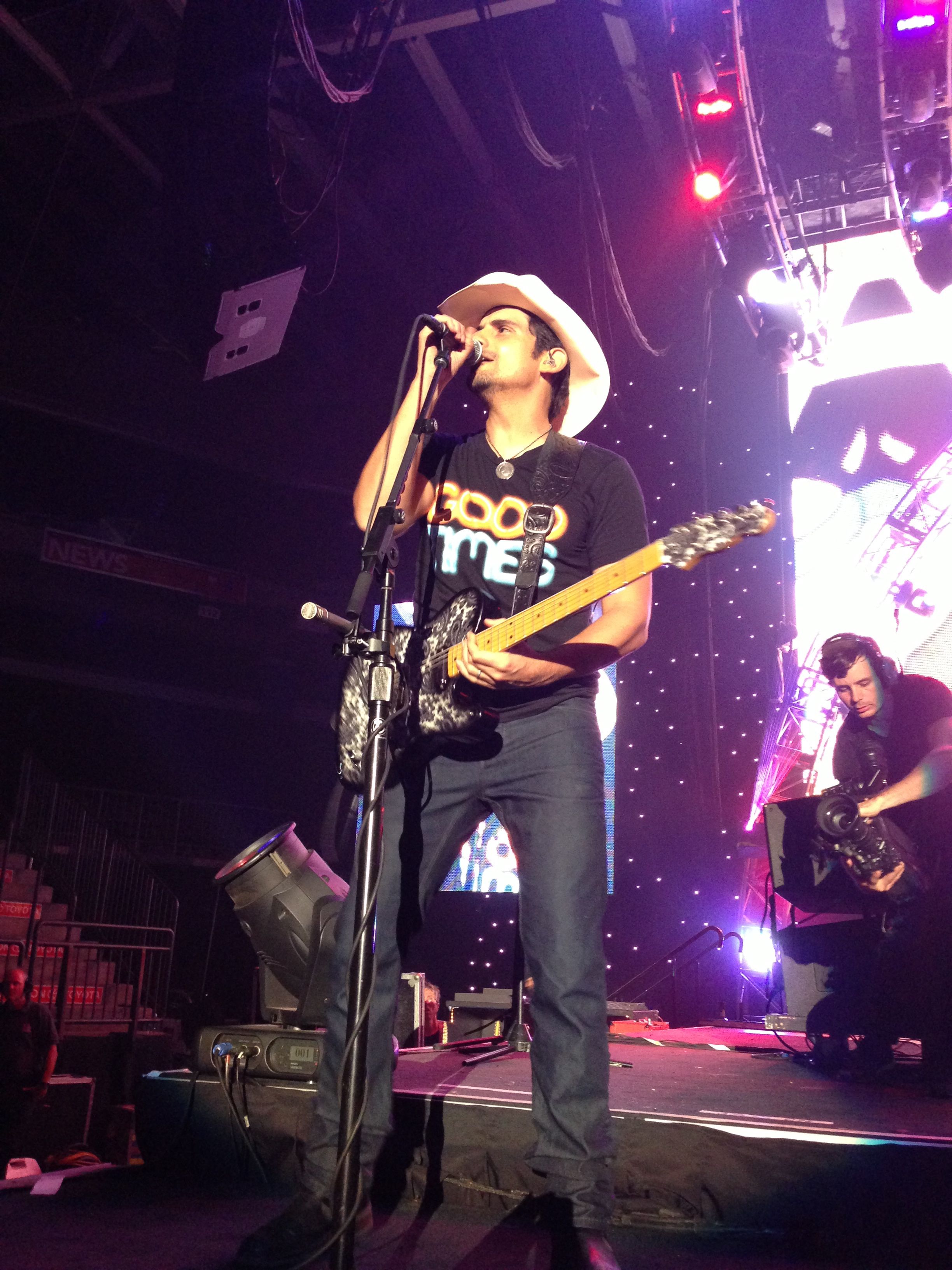
Yes, we were that close, an arms reach away from his mic stand on the left side of the stage.

He’s sang most of these songs a million times, but you can tell he’s passionate about them all and pours his heart into each one.

Like I said…pours his heart into each one!

And the man can really play guitar too, a quality that is often overshadowed by how great his singing is at live shows. He really doesn’t skip a beat from what you hear on his records, if anything he takes it up another notch.

He used a half-dozen different guitars and rarely put the instrument down, but he did so briefly during Mud On The Tires which struck a chord with the crowd on what was a rainy evening with puddles forming in the parking lot prior to his show.
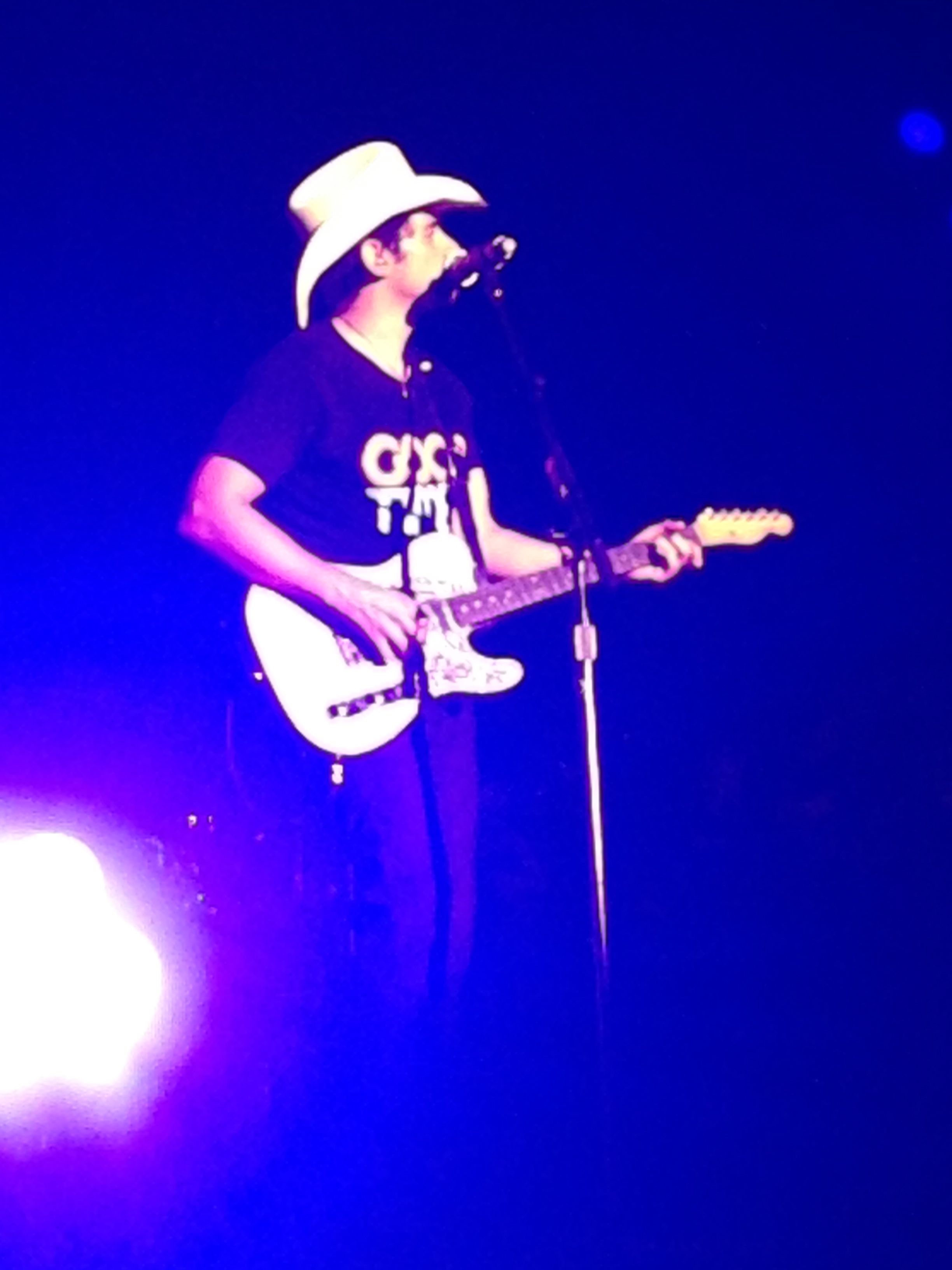
As much as I chirped his “light show” during Beat This Summer, the stage lighting was solid overall and made for some neat photo opportunities as evidenced here.
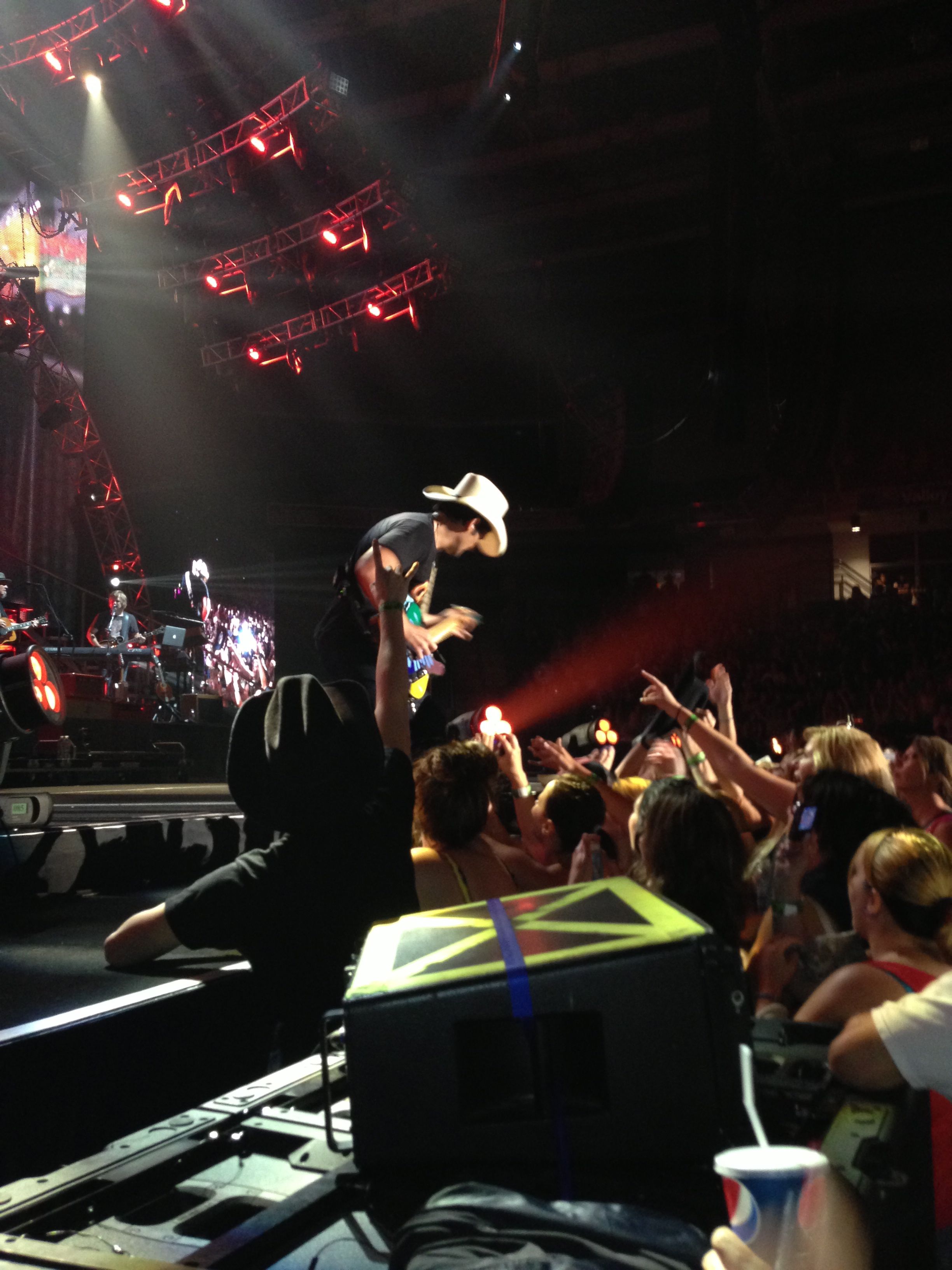
Paisley played to the crowd throughout and definitely explored his space on the stage. Here he is in the centre of the stage and as you can see my “arms length” comment was no exaggeration.

Here he ventured out to a secondary island stage surrounded by very appreciative fans.

Here’s another nice shot showcasing the big screen that backed his stage, with Paisley off to the right singing This Is Country Music (I think).

He even had a raised portion of the stage that he performed the occasional guitar solo from as seen here.

His didn’t incorporate a ton of props but this “stunt double” made a token appearance during Celebrity. Of course, Sarah also turned the camera on herself a time or two, including this cute pic prior to departure. She totally pulls off the cowgirl look, right down to the beer in hand!
 I took a picture of myself too while Sarah was putting on her finishing touches. Mine turned out a little less graceful in this classic “douche mirror” shot.
 Sarah snapped this keeper on the drive there, quite possibly looking better than ever (in my not so humble opinion).
 When she wasn’t busy capturing Brad’s best moments, Sarah managed to catch me getting into the act and clearly enjoying myself. What a great time it was and mostly thanks to her!
COG 2013: Fun in the (occasional) Sun
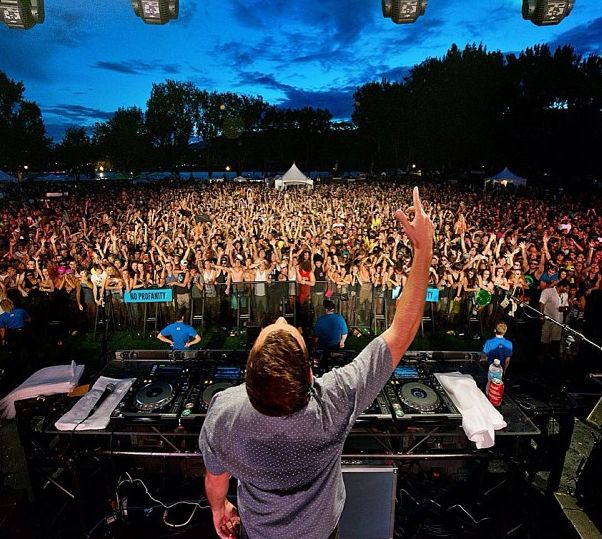
Photo courtesy Twitter
Kaskade plays to the crowd during his headlining set on Friday night at Center of Gravity. By all accounts from those in attendance, the Las Vegas-based DJ “killed it” in Kelowna and set the stage for those to follow throughout the weekend festival.
Another memorable Center of Gravity festival has come and gone over the August long weekend in Kelowna.
This year’s event, the sixth annual under the COG banner, delivered arguably the best collection of music and sports entertainment to date despite less than ideal weather conditions at times. Mother Nature held off on the rain for the most part over the three days, and constant cloud cover did little to dampen the spirits among thousands of concert-goers.
Tiesto, a world-renowned DJ from the Netherlands, closed the show with a powerful and captivating performance Sunday night that had the capacity crowd in a frenzy at City Park. Tiesto’s act followed stellar sets by fellow headliners, Kaskade on Friday and Cazzette on Saturday. Also showcasing their wide-ranging talents on the main stage were the likes of Wolfgang Gartner, Dada Life, Tommy Lee (with DJ Aero and SOFI), Lights and several more.
For the sports enthusiasts, there was a little something for everyone. The Dirt Zone was extra popular this year, with organizers combining freestyle motocross with mountain biking for the first time in history. It was well received by fans who couldn’t get enough of the daring two-wheeled tricksters.
Offering a cooler — or at least wetter — experience was the Water Zone, where some of the planet’s best wakeboarders and wakeskaters busted out equally impressive maneuvers. In another new twist this year, the riders were pulled by an innovative 2.0 cable system rather than by boat, which made their runs quicker in succession with next to no wait between competitors.
There was also skateboarding on display in the Urban Zone, plus 4-on-4 basketball in the Hoop Zone and beach volleyball at Hot Sands Beach.
So, literally, something for everyone. Well, except perhaps for those ice hockey fans who were forced to broaden their horizons in the off-season.
For those not fortunate enough to attend this year’s festival, Sarah Offermann and myself were able to capture the following images to hopefully showcase some of the electric atmosphere from all facets. It’s only a small sample of what COG has to offer, and the only way to experience the full realm is to make next year’s event a reality. Until then, enjoy this photographic recap:
From the Main Stage

Tiesto performs under his flashing nameplate during Sunday’s finale. The next five shots are also from Tiesto’s set.






The boys in blue — or in this case neon green — look on during Wolfgang Gartner’s set on Sunday. There was significant police presence throughout the concert grounds, ensuring everybody stayed safe in the fun environment. The next photo captures a female fan on the shoulders of a male friend in front of a giant screen as Wolfgang Gartner performs.


Fans flocked to watch Dada Life’s show on Friday, which was — as always — aided by several stage props, from their trademark bananas to the giant inflatable sign visible in this photo.
From the Dirt Zone
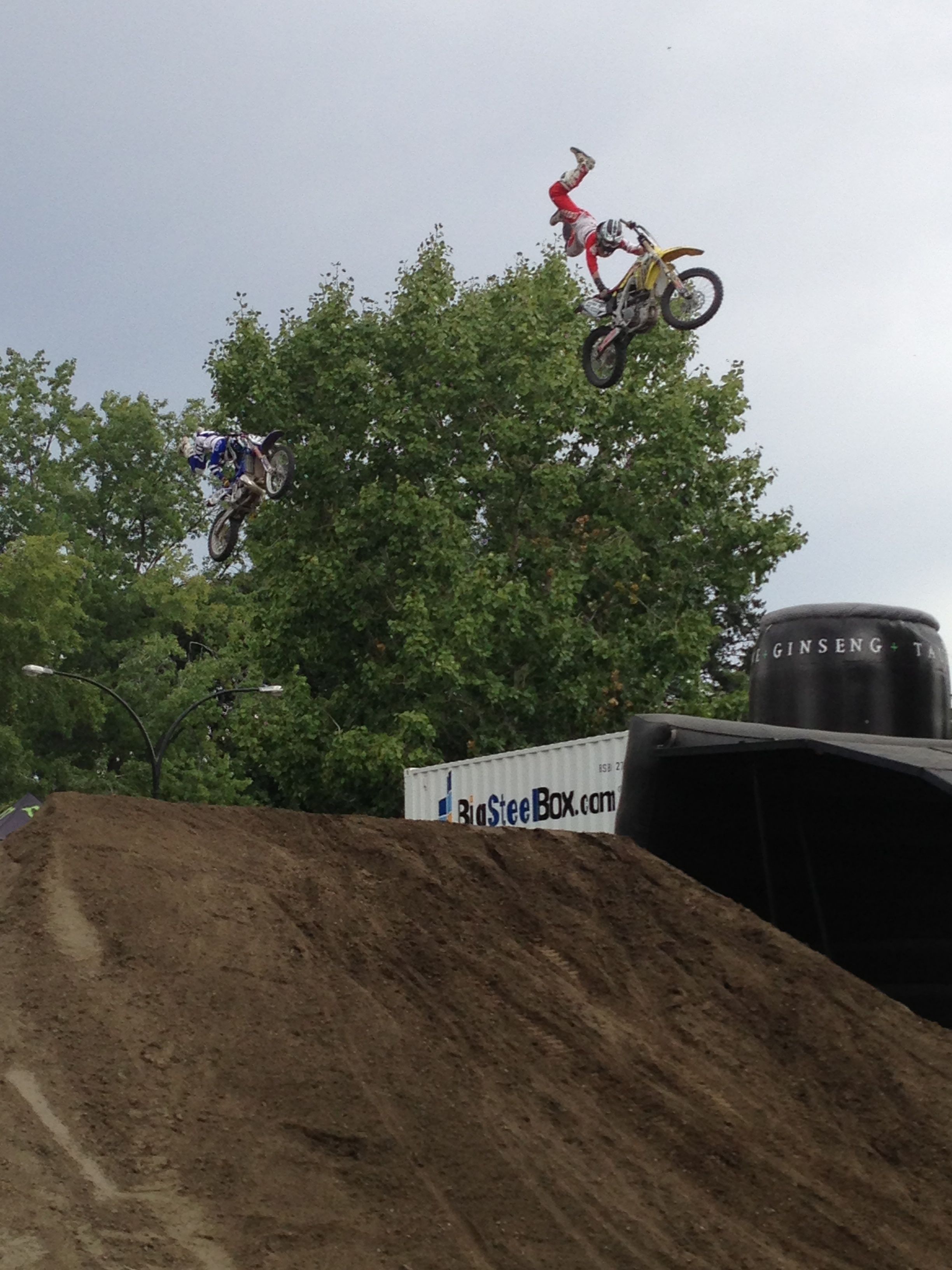
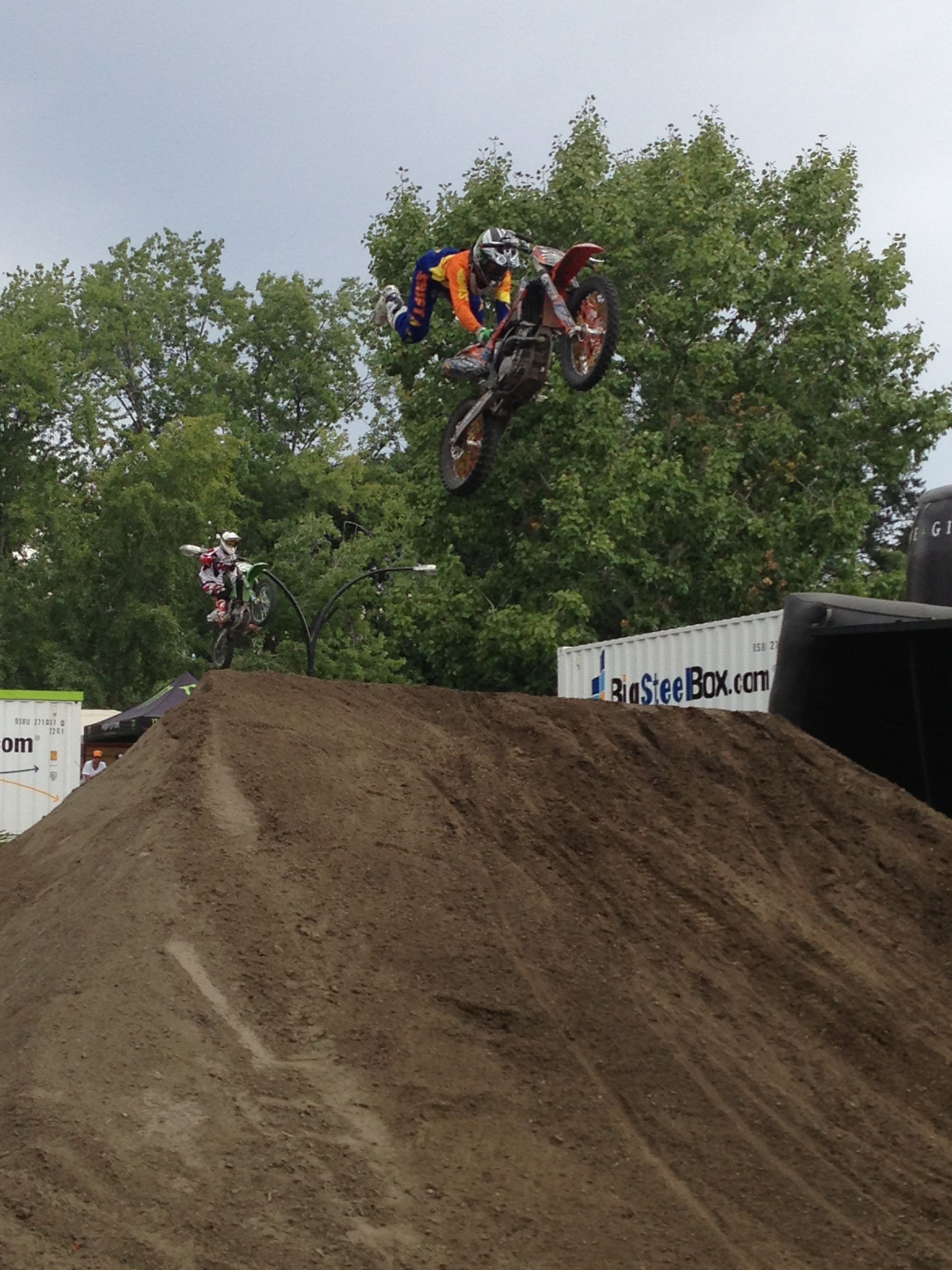
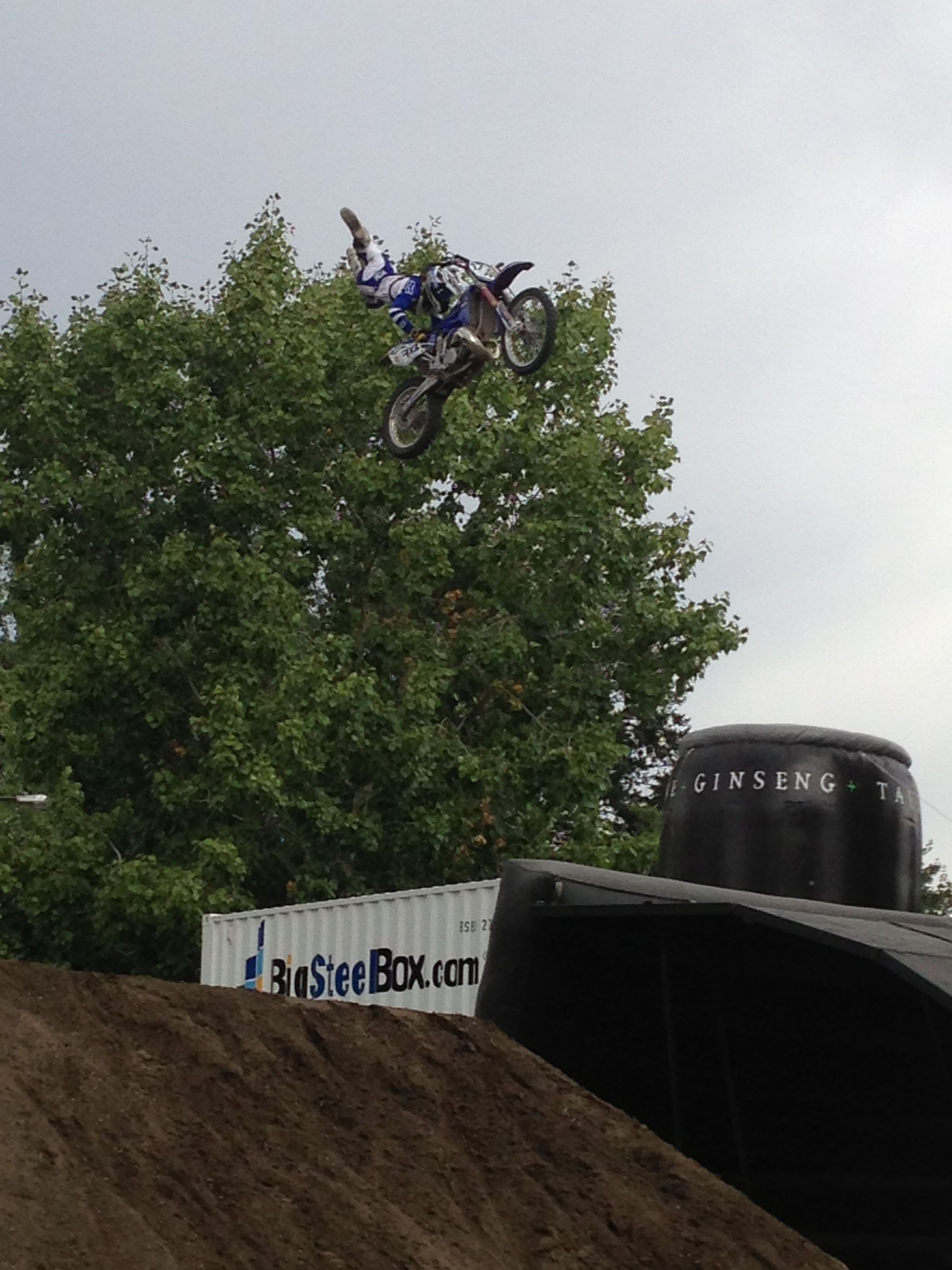
Two freestyle motocross riders soar high above their landing ramp during Saturday’s competition. The lead rider performs what one onlooker dubbed a “gnarly” trick that produced enough applause to drown out the sound of his engine. The next three photos were also snapped during Saturday’s freestyle motocross action.

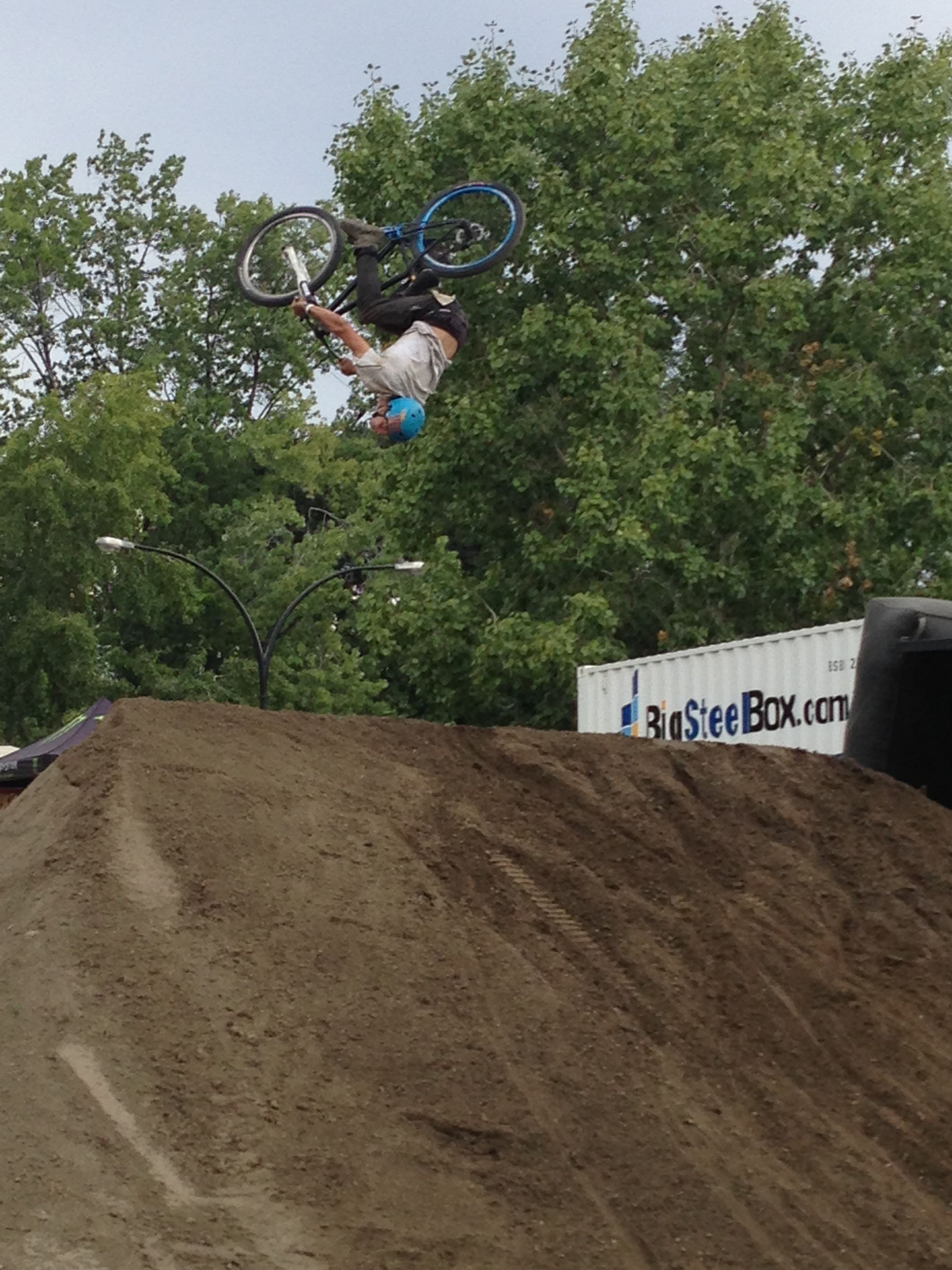
Equally daring were the mountain bikers who were charged with following up the death-defying motocross display on Saturday. While the motocross riders landed all of their tricks relatively unscathed, some of the mountain bikers weren’t as fortunate, though there were no serious injuries reported as most were able to laugh off their cringe-inducing tumbles. The next seven photos will depict that and more.
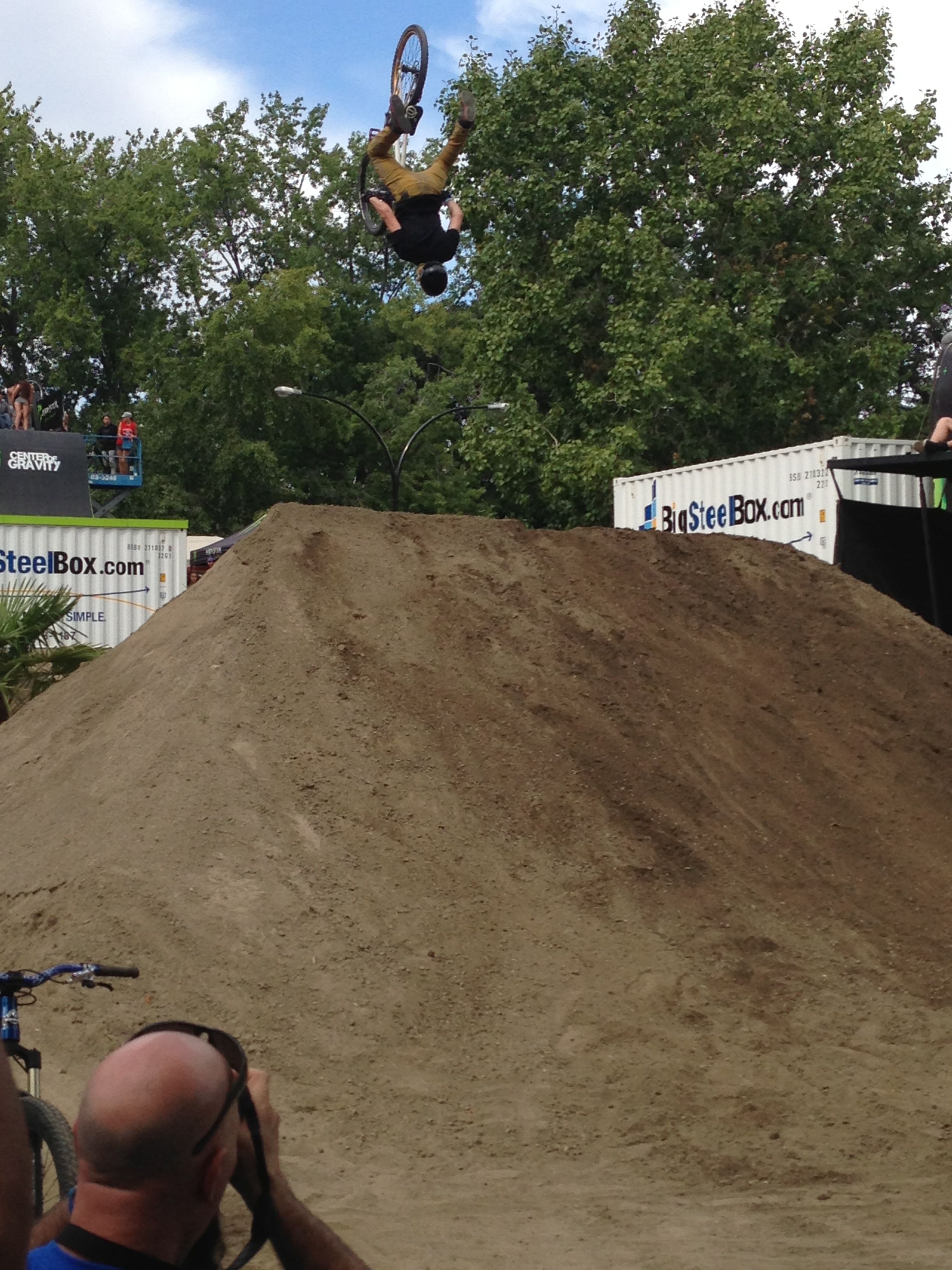


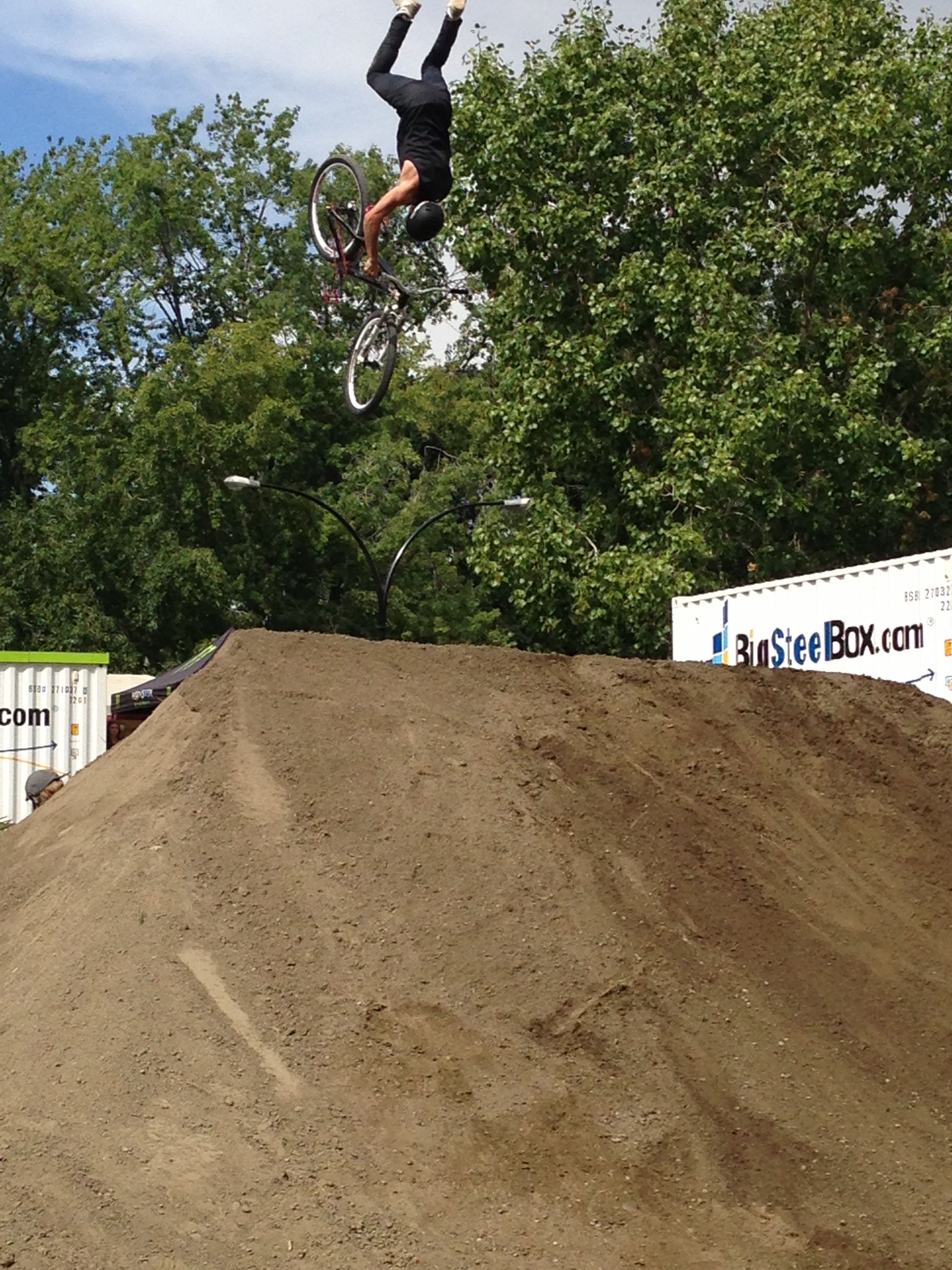
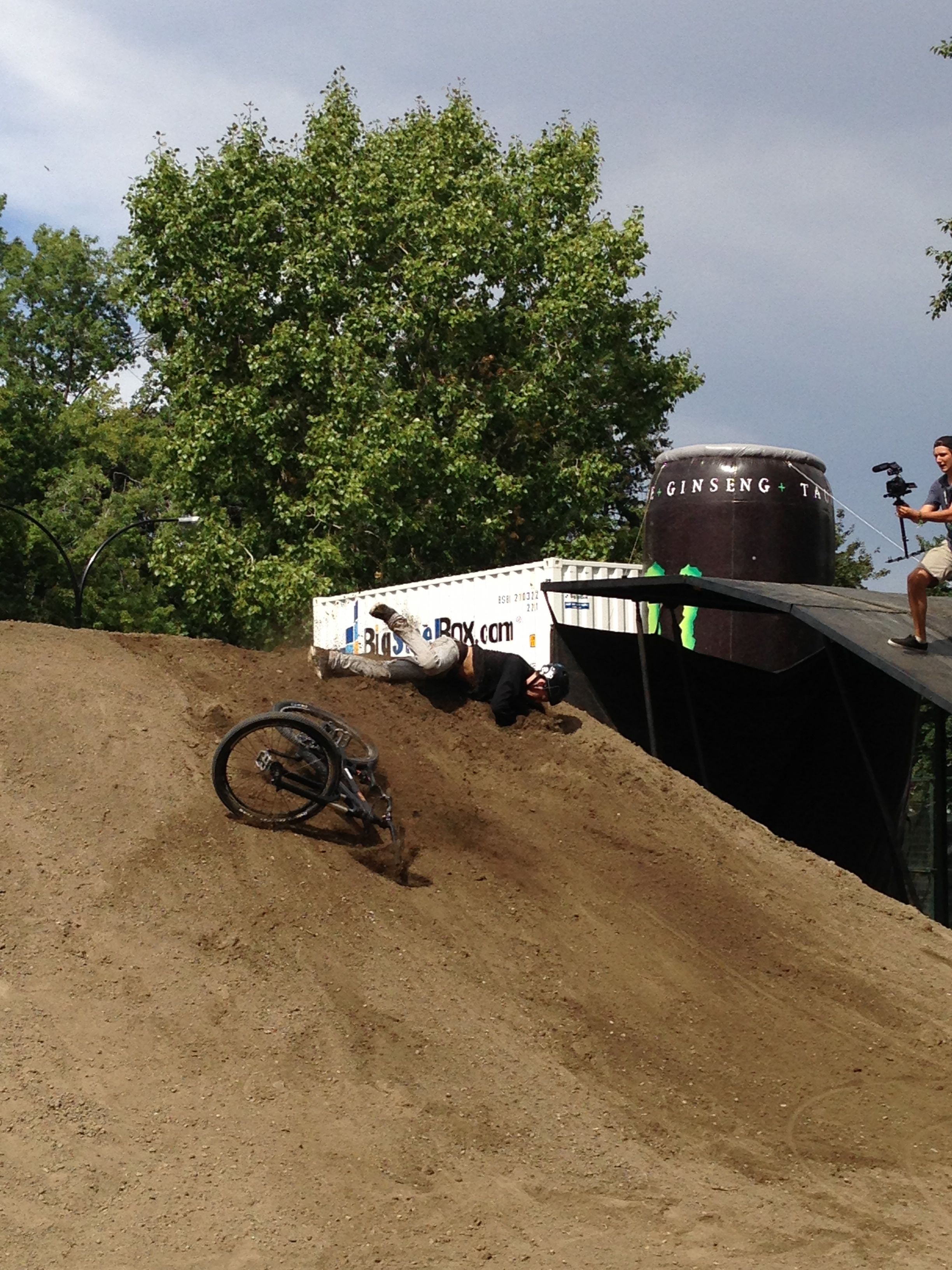
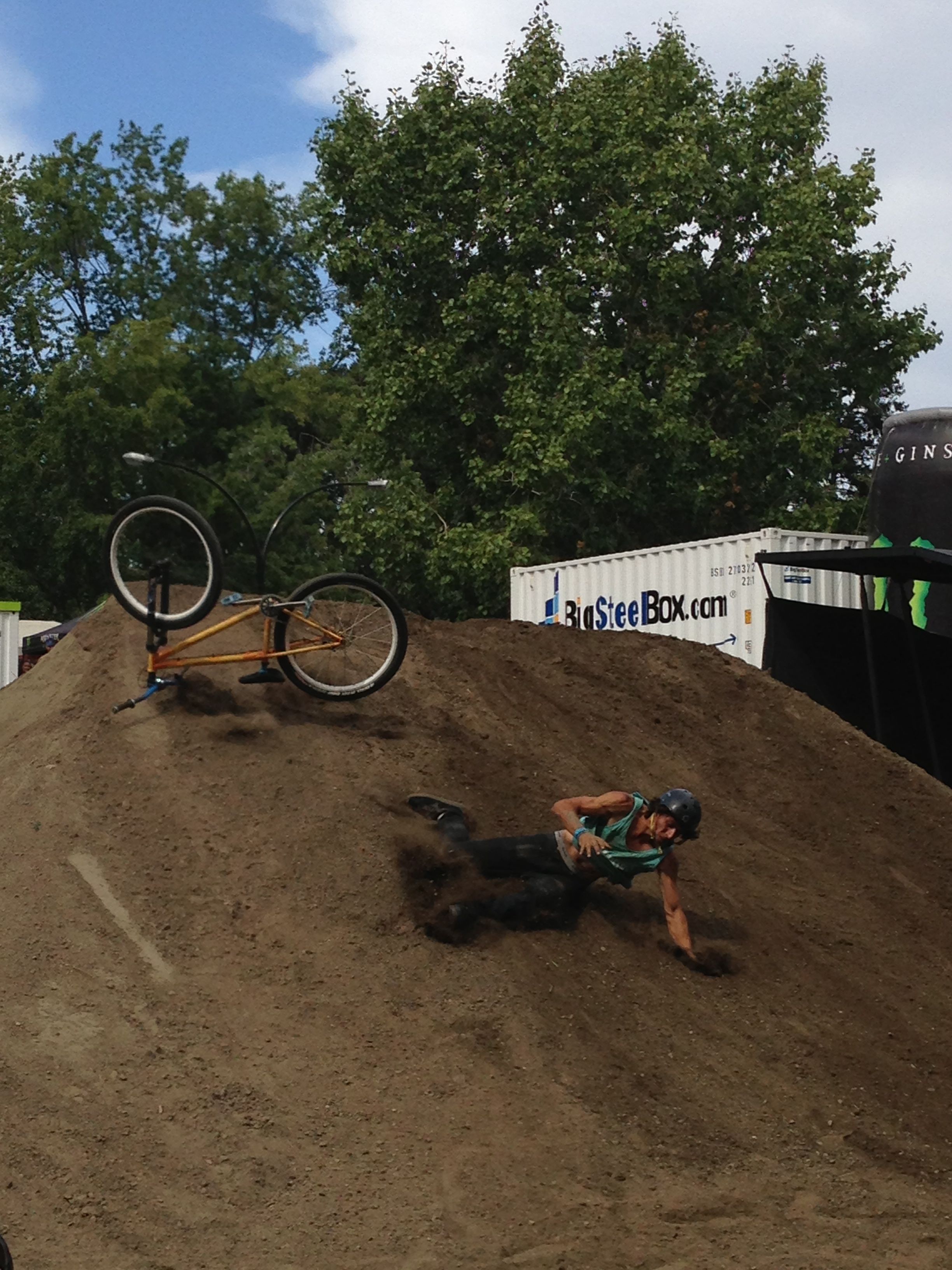
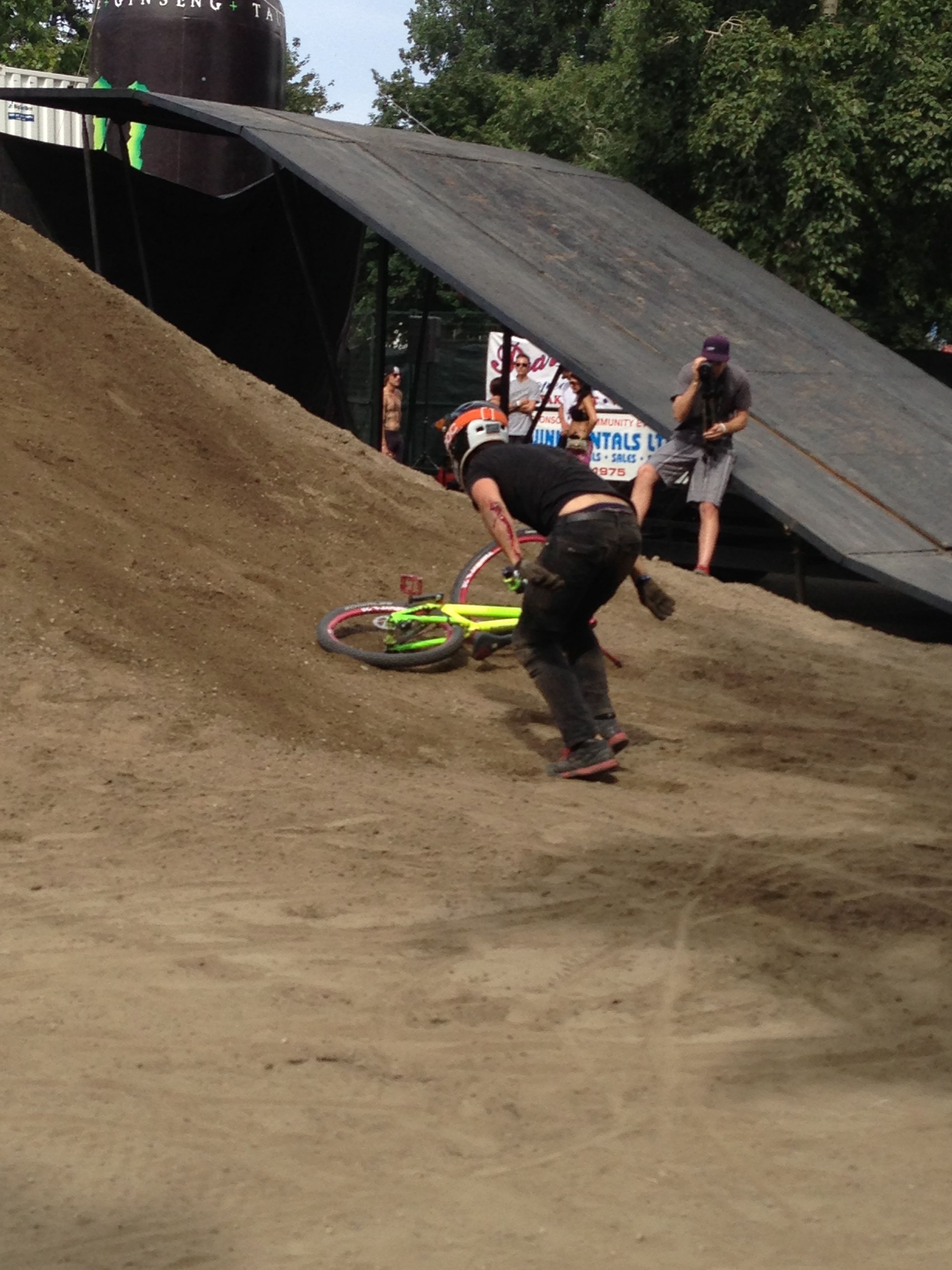
Yes, that is blood — not dirt or ketchup — covering this biker’s forearm. Not to worry, he shook it off and was at the top of the drop zone again for his next run. The pain threshold of the bikers was almost as incredible as the tricks they were pulling off, but like they say “practice makes perfect.”
From the Water Zone
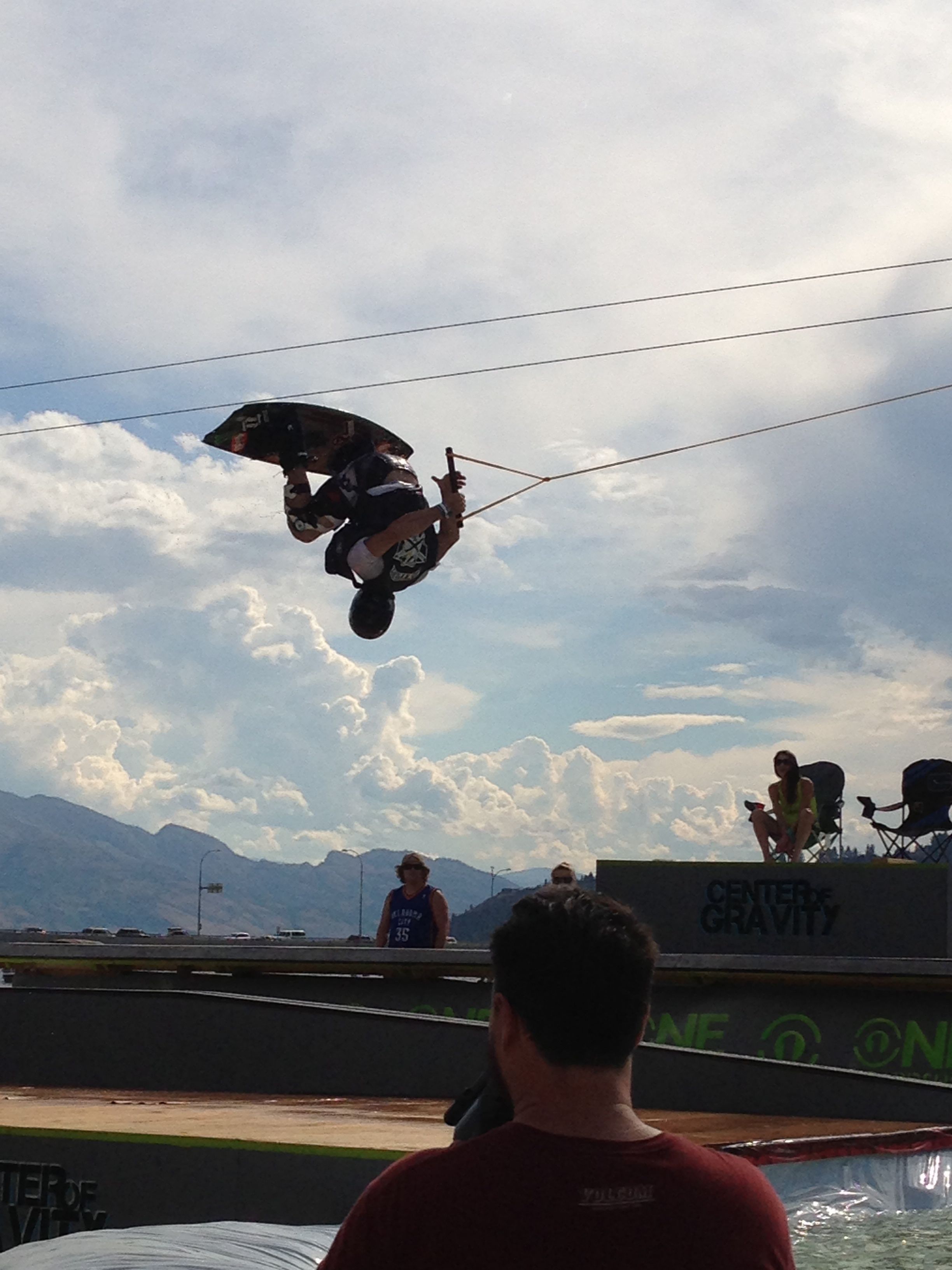
Shane Bonifay of the United States busts out a big-air move during Sunday’s wakeboarding finals. Bonifay was among the favourites to win the event and didn’t disappoint in successfully landing all three of his crowd-pleasing jumps. The next nine shots to conclude this slideshow came from the same competition.

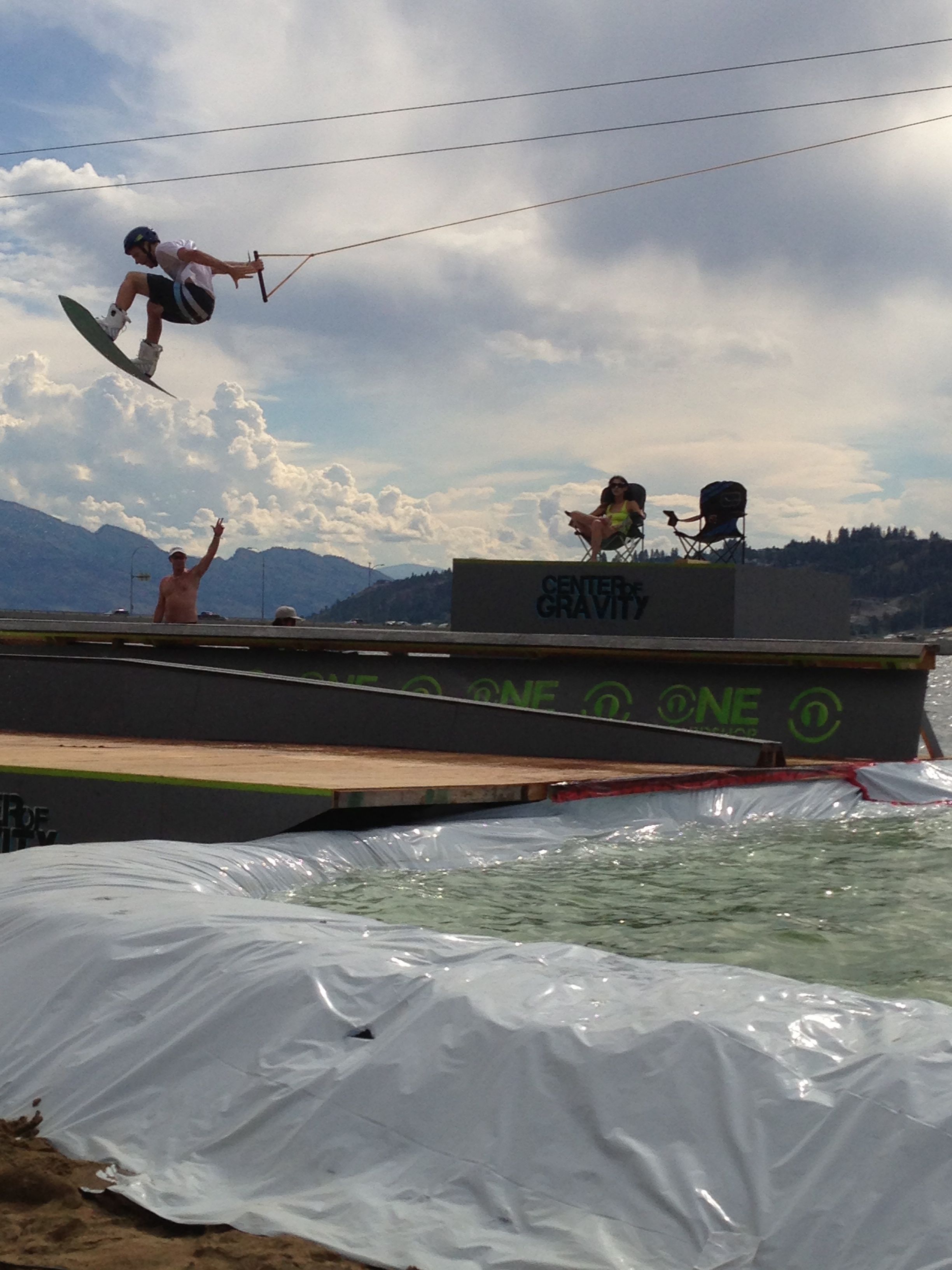
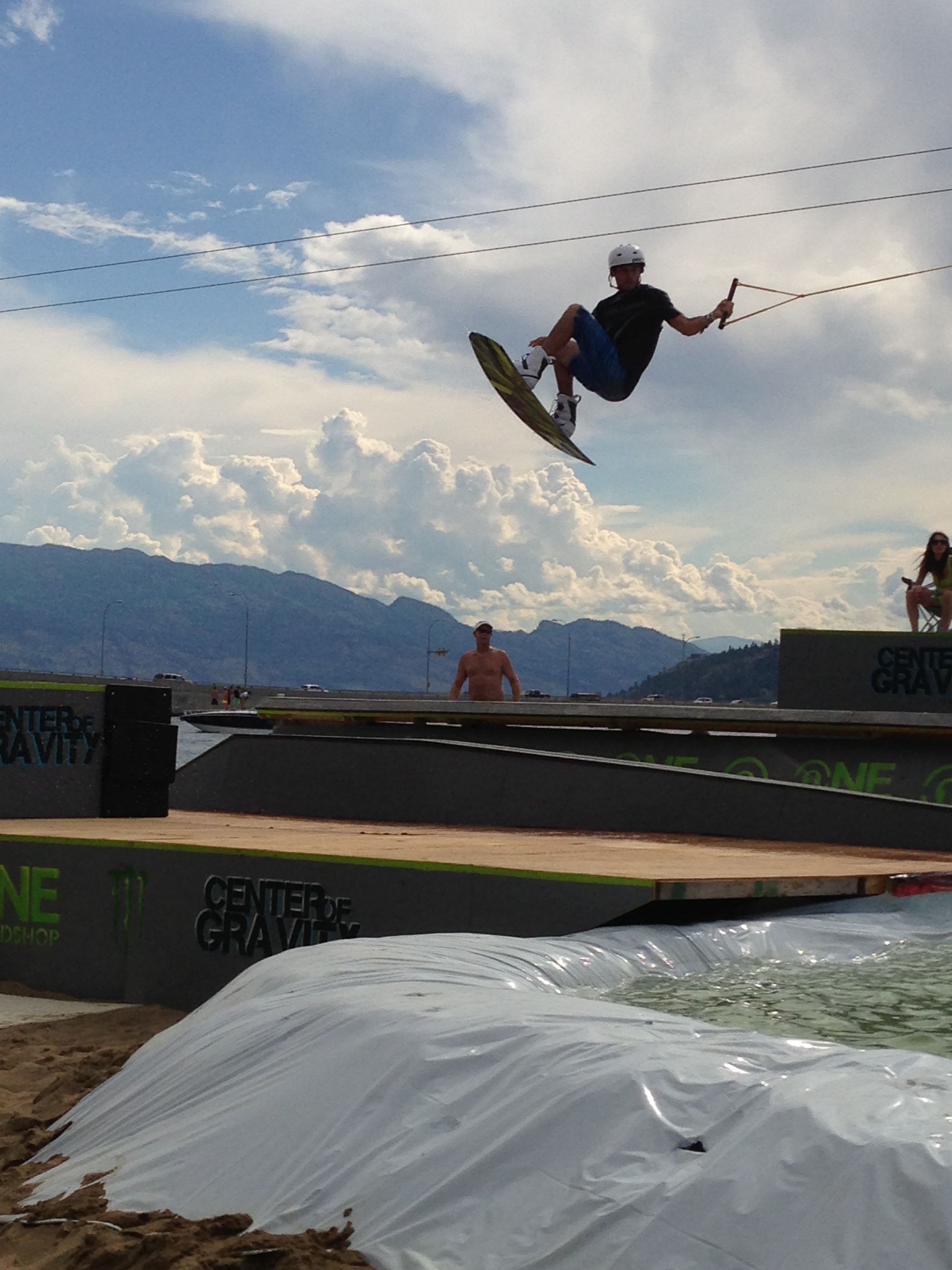

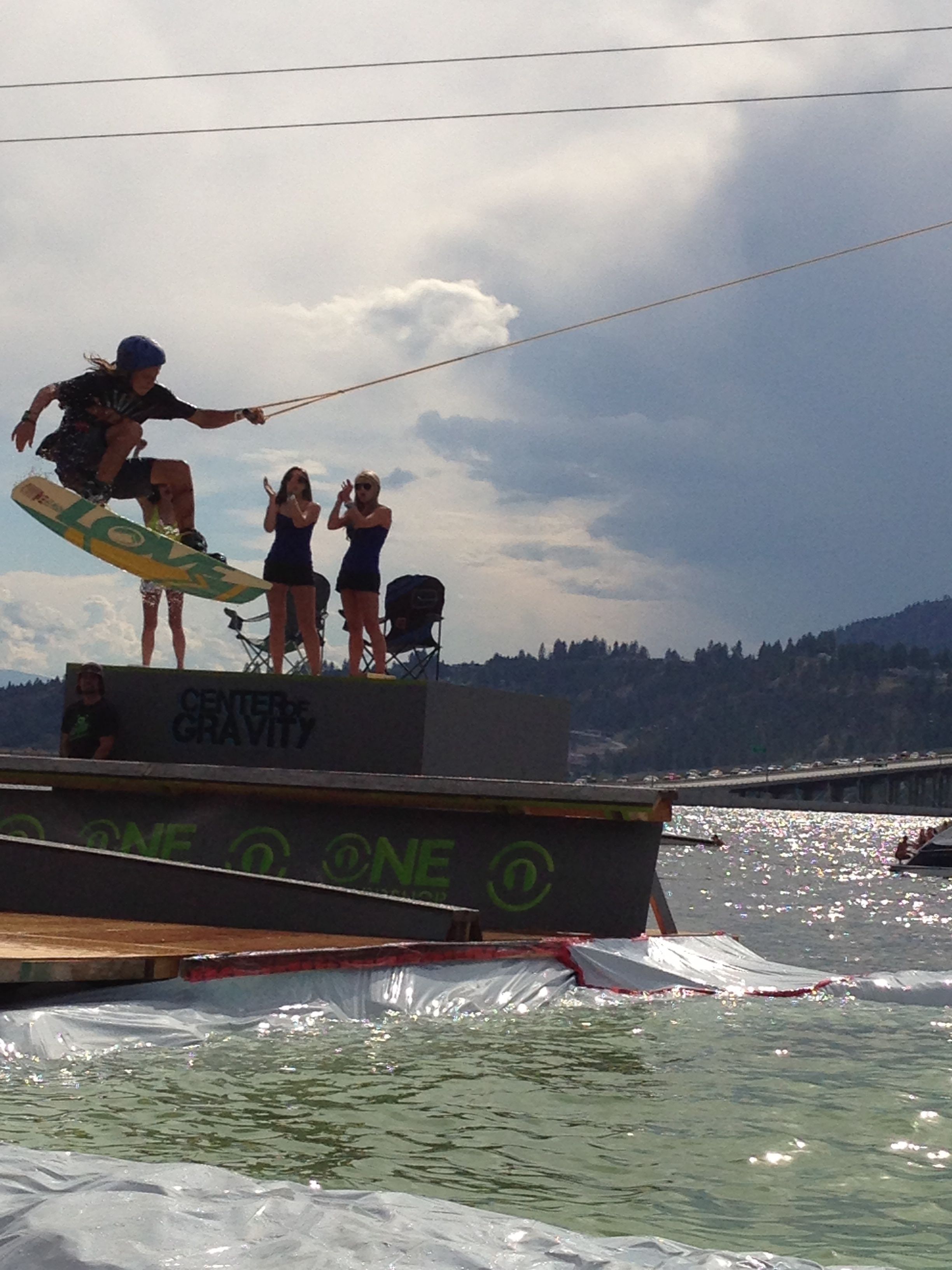
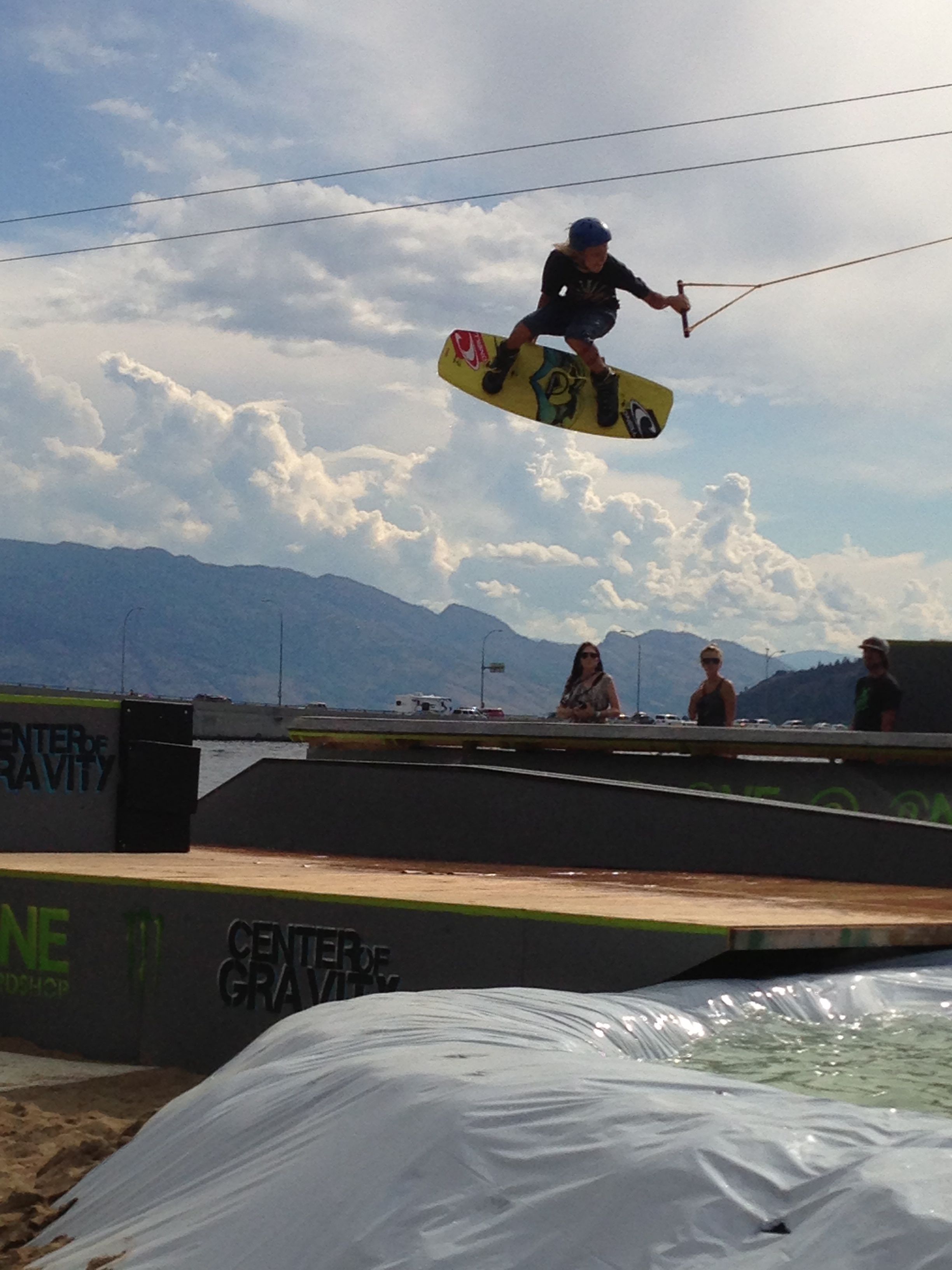

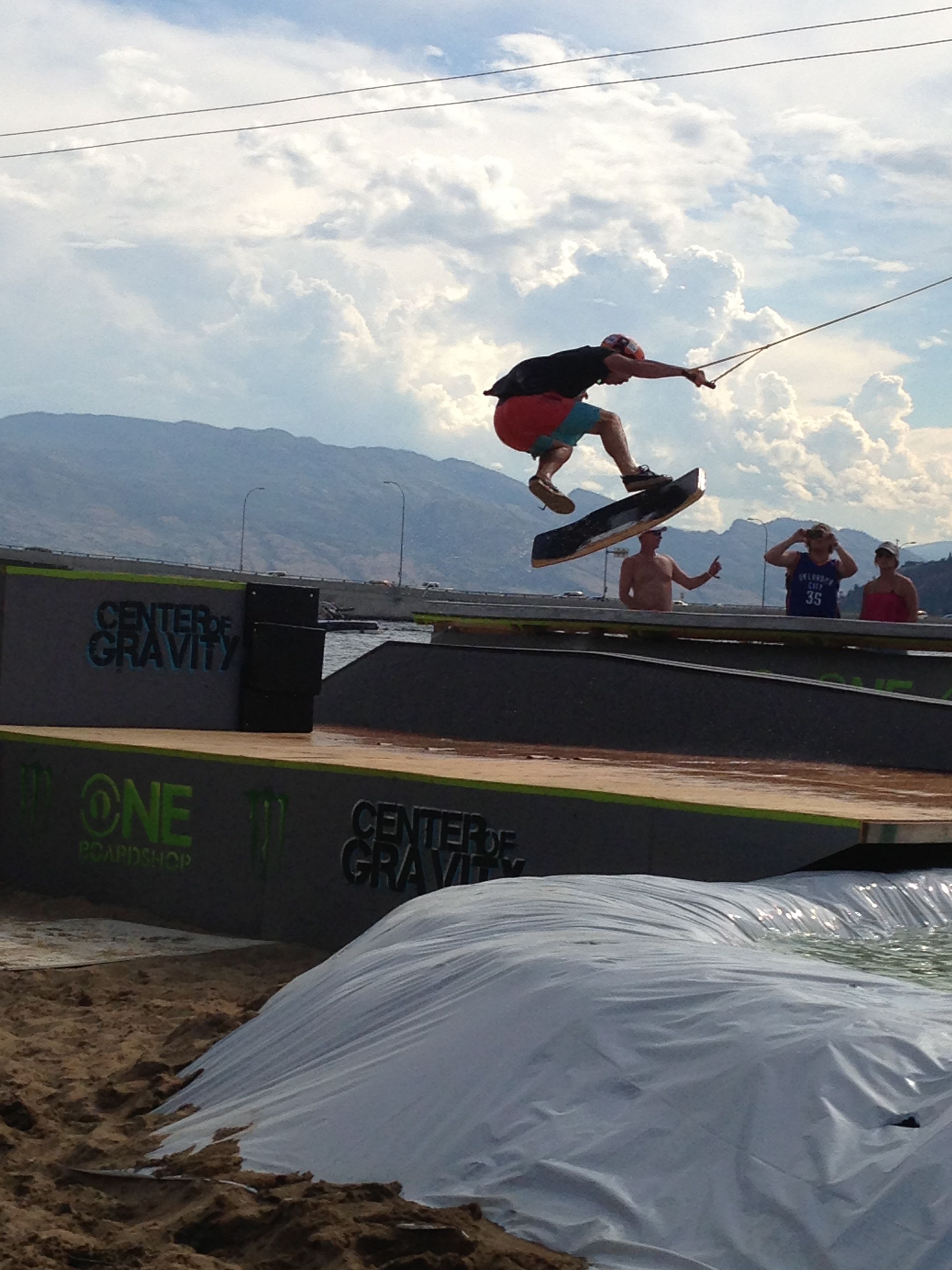
If this board looks a little unusual, that’s because it is, belonging to a wakeskater rather than a wakeboarder. With no bindings or boots, wakeskating appears much more difficult although this rider made it look relatively easy on most of his weekend passes.
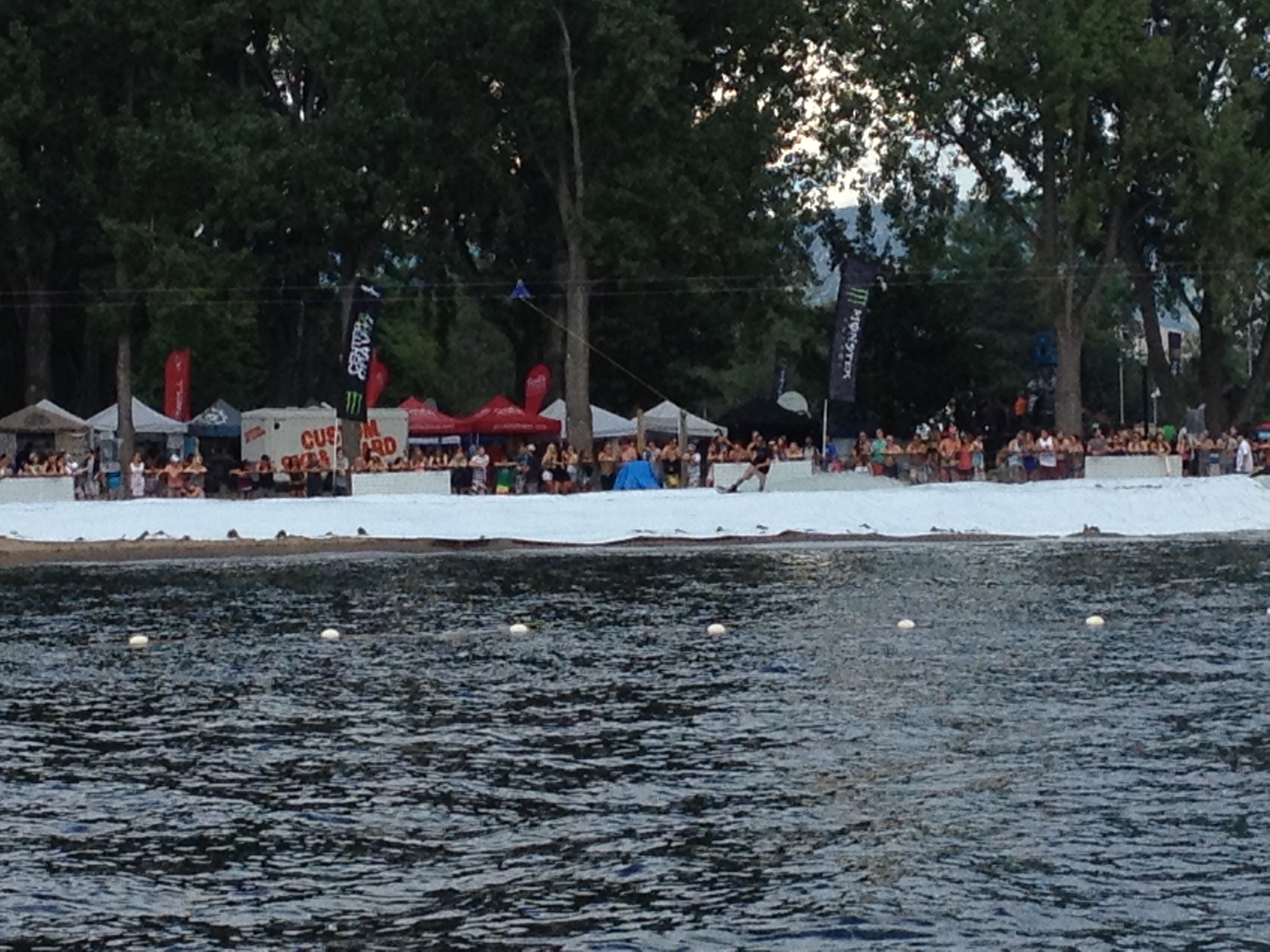
Spectators weren’t limited to the shores of Hot Sands Beach, as several boats floated nearby the Water Zone to watch the action.
Making The Team Canada Cut
Hockey Canada will host an Olympic orientation camp in Calgary next month, featuring 47 of the country’s best NHL players — who may or may not take the ice — in preparation for the 2014 Winter Games in Sochi, Russia.
Personally, with insurance costing roughly $1 million for the weekend gathering — or $21,276 each — I would hope the players pony up to increase their chances at gold with additional on-ice chemistry. Surely, if they don’t and other nations do, Canada will be a step behind and critics will hold them accountable for any shortcomings in February — such as silver, bronze or, heaven forbid, no medal at all.
There’s still plenty of time to figure that out, and even more time to finalize the 25-man Olympic roster ahead of the Dec. 31 deadline. The latter decisions lie in the hands of Steve Yzerman and company, and the first three months of the NHL season will largely influence who makes the cut.
That said, there are already the proverbial locks — at least a half-dozen, maybe even a dozen players who are assured spots in Sochi, barring injury between now and then. But it’s often said Canada could ice two medal teams and these Olympics are no exception, though the Americans, host Russians, Swedes, Finns and lesser lights such as the Swiss, Slovaks and Czechs would all beg to differ.
On paper, though, Canada will certainly enter the tournament as the odds-on favourite, not to mention the defending champions from the 2010 Vancouver Games.
Yzerman has indicated there will be a changing of the guard this time around, and the invitation list to orientation camp echoes that sentiment with 2010 veterans Martin Brodeur and Jarome Iginla not attending and key defencemen Scott Niedermayer (retired) and Chris Pronger (injured) no longer in the picture.
There has also been little to no fanfare for Dan Boyle or Joe Thornton in terms of making the 2014 edition, while fellow 2010 holdovers Brenden Morrow, Dany Heatley and Marc-Andre Fleury have also become afterthoughts for arm-chair GMs trying to assemble their golden lineup.
Instead, a new wave of talent is likely to take the torch and replace their roles, led by a trio of first overall draft picks in Steven Stamkos, John Tavares and, potentially, Taylor Hall.
Just how much turnover will there be? I’m honestly thinking 45 per cent — yes, essentially half the roster, or nine of the 20 players in Canada’s starting lineup on Feb. 13 against Norway. In that estimation, I have five new forwards, three new blue-liners and one new netminder — plus a few more fresh faces among the five ‘taxi squad’ reserves.
Without further a do, here’s my Canadian roster for the 2014 Olympics, with reasoning to follow:
Forwards
Eric Staal-Sidney Crosby-Steven Stamkos
Rich Nash-Jonathan Toews-Claude Giroux
John Tavares-Ryan Getzlaf-Corey Perry
Logan Couture-Patrice Bergeron-Jamie Benn
Taxi Squad = Taylor Hall, Andrew Ladd and James Neal/Patrick Sharp
Defence
Shea Weber-Drew Doughty
Duncan Keith-Brent Seabrook
Kris Letang-Alex Pietrangelo
Taxi Squad = P.K. Subban/Marc Staal/Mike Green
Goaltenders
Carey Price
Roberto Luongo
Taxi Squad = Cam Ward/Corey Crawford
Starting from the top, with the forwards, I think Stamkos, Giroux and Tavares are already penciled in among the top 12 providing they are healthy and productive, as expected, at Christmastime. I’m also fairly confident that centre depth will be reflected on the final roster. If I had to label three forwards as “on the bubble”, it would Perry, Couture and Benn. Perry has been a staple with Hockey Canada and always seems to deliver, but he’s not the best skater and these Olympics are being played on the bigger ice surface again. Couture and Benn would be newcomers and could easily be upstaged by Hall, Ladd, Neal or Sharp. Benn wasn’t even invited to the orientation camp — albeit shockingly — so I’m going out on a limb by listing him among the top 12 and he’ll be hard-pressed to achieve that. But those six are pretty interchangeable in my opinion, and I wouldn’t go as far as to call Perry’s spot safe, either, although his chemistry with Getzlaf should also work in his favour.
Defensively, I think the top four are set in stone and will remain the same as in Vancouver. The bottom pairing could go a few different directions, but I think Letang and Pietrangelo would complement each other nicely. If Letang struggles or gets hurt again early in the NHL season, then Subban could be paired with Pietrangelo or they may prefer more of a shutdown replacement in Marc Staal. The other wild card would be Mike Green, arguably Canada’s best offensive defenceman, and he looked like his old self for Washington down the stretch and into the playoffs last season. If Green picks up where he left off and stays healthy until Christmas, he may very well enter the conversation.
Last but by no means least, goaltending is Canada’s biggest question mark. Luongo is the incumbent starter, but he’s not even the incumbent starter on his own NHL team these days, having been supplanted by Cory Schneider in Vancouver. He is, however, the default starter now that Schneider has been shipped to New Jersey to compete with Brodeur, another former Canadian Olympic goaltender nearing retirement. Luongo is still in his prime years, but he hasn’t been that spectacular in recent seasons since the 2010 Games. But nor has any other Canadian between the pipes, at least not with any alarming consistency. Price is often thought to be the heir apparent to Canada’s goaltending throne and he’s shone on the big stage before at the world juniors and in winning the AHL’s Calder Cup. But Price hasn’t fully lived up to expectations, or his potential, in Montreal where he was also outplayed by former Hab Jaroslav Halak a couple years back and wasn’t at his best in a first-round playoff upset loss to Ottawa this spring. Fleury has been worse, much worse, the past two playoffs — ultimately losing his starting job to Tomas Vokoun. Ward wasn’t invited to the orientation camp, perhaps still recovering from a knee injury that prematurely ended his season, but if healthy, he has the ability to be in the mix and has played well at world championships over the years. Ward is my dark horse, but he would also have to outperform reigning Stanley Cup champion Corey Crawford of Chicago, Mike Smith of Phoenix and Braden Holtby of Washington, all of whom are slated to join Luongo and Price at the summer camp.
Taking everything into account at all three positions, it’s evident that competition will once again be steep for those hoping to crack Canada’s Olympic roster. Crosby, if his health holds up — and that’s a fair-sized IF — will likely captain this team, having scored the gold-medal-winning goal in overtime against the rival United States in 2010. Leadership won’t be an issue, with several of Canada’s prospective players wearing captaincy letters on their NHL teams. If the goaltending dilemma solves itself and the appointed starter is anything above average, then I like Canada’s chances to repeat as Olympic champions and top the podium in Sochi. If the goaltending falters, as has been the case at recent world juniors, then Canada will have its work cut out and may need to outscore the opposition to accomplish the same feat, which will be no easy task. Time will tell, but I would agree with the odds-makers that Canada is still the team to beat at the outset of the Games.

2013 Mock Draft: 2 Rounds of (Slightly) Educated Guessing

Top prospects for this Sunday’s NHL Entry Draft, from left, Nathan MacKinnon, Seth Jones and Jonathan Drouin pose together at the 2013 Memorial Cup in Saskatoon last month. MacKinnon and Drouin teamed up to lead the Halifax Mooseheads over Jones and the Portland Winterhawks in the tournament’s championship game.
It’s that time of the year again — mock draft time.
With less than a week until the 2013 NHL Entry Draft in Newark, N.J., on June 30th, prospect junkies from around the world are taking their best shot at predicting which teams will pick which players. It’s never an easy process and there are always surprises on draft day, whether it’s the highly ranked prospect falling to the middle of the first round or the relatively unheralded prospect getting selected much sooner than expected.
Last year’s draft, for example, had an early run of defencemen that caused European forwards Filip Forsberg and Mikhail Grigorenko to drop out of the top 10, though both still wound up making their NHL debuts this past winter.
In my annual mock draft, I had them going second and third, respectively, behind first overall selection Nail Yakupov, when in reality they went 11th and 12th, respectively.
Overall, I correctly predicted 25 of the 30 players picked in the 2012 first round — missing Scott Laughton, Mike Matheson, Jordan Schmaltz, Henrik Samuelsson and Tanner Pearson. That sounds pretty good, but — and it’s a big BUT — Yakupov was the only player among those 25 that I matched with the right team. So, mixed results at best.
This year promises to be no different, with the 2013 draft class exceptionally deep and categorized by some as the best in a decade — since the stacked 2003 draft.
For a change, the Edmonton Oilers won’t have the No. 1 pick — barring a blockbuster trade — after three straight years of picking first and landing Taylor Hall, Ryan Nugent-Hopkins and the aforementioned Yakupov.
The Colorado Avalanche currently have that honour and assuming the order stays the same — which it never does — here is how I see the opening two rounds playing out. For the record, I went two rounds deep instead of one this year due to the amount of quality prospects past the top 30.
First Round

Nathan MacKinnon
1) Colorado Avalanche: Nathan MacKinnon (C, QMJHL, Halifax) = Joe Sakic is in a win-win situation with his first trip to the draft podium, having the choice between a high-scoring Canadian forward in Nathan MacKinnon or a big American defenceman with a diverse skill-set in Seth Jones. Both are proven winners — MacKinnon recently hoisting the Memorial Cup and Jones previously capturing world-junior gold — and both appear primed to make immediate impacts in the NHL next season. If Sakic was to simply flip a coin, he probably couldn’t go wrong here, but Sakic, new head coach Patrick Roy and some of the team’s scouting staff have instead gone on the record to indicate they are “leaning towards MacKinnon” and “the forward(s) is too good to pass up.” So despite the fact Jones has Denver roots (his dad Popeye played for the NBA’s Nuggets) and he grew up as family friends with Roy, it seems MacKinnon is Colorado’s target and I’m not about to call their bluff. That said, I believe taking Jones would address a bigger organizational need for the Avs than MacKinnon, who projects to be a better version of Gabriel Landeskog, who Colorado selected second overall in 2011.
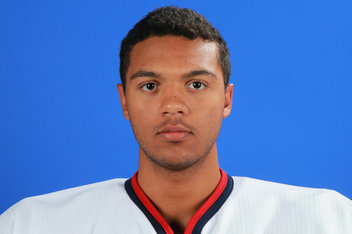
Seth Jones
2) Florida Panthers: Seth Jones (D, WHL, Portland) = This pick becomes a no-brainer, in my opinion, for Dale Tallon. While MacKinnon might have been the perfect complement to Jonathan Huberdeau, the third overall pick in 2011, Jones is the best player available at No. 2 (and arguably at No. 1), and he’ll be a cornerstone on the blue-line in South Florida for the next decade. Unless, of course, Tallon trades up to select MacKinnon, who I assume was his No. 1 choice as well.
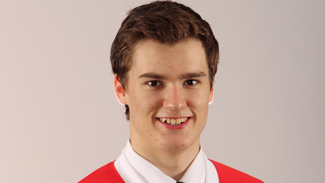
Jonathan Drouin
3) Tampa Bay Lightning: Jonathan Drouin (LW, QMJHL, Halifax) = After those potential franchise players are off the board at 1-2, things get a little dicey. Steve Yzerman and his staff could go a few different directions at No. 3 and reports indicate they are mulling several options — namely, MacKinnon’s wingman with the Halifax Mooseheads, Jonathan Drouin, plus two European power forwards in Russia’s Valeri Nichushkin and Finland’s Sasha Barkov. In the end, I can’t see the Lightning passing on Drouin, who has drawn comparisons to Patrick Kane and could be an ideal replacement for the aging Martin St. Louis.

Sasha Barkov
4) Nashville Predators: Sasha Barkov (C, Finland, Tappara) = That brings us to the Predators, who have a need for size and scoring ability among their forward group, with Barkov surely fitting the bill. David Poile dealt for Filip Forsberg at the trade deadline, sending Martin Erat to Washington, and Barkov should gel well with Forsberg as a 1-2 punch in Music City for years to come.
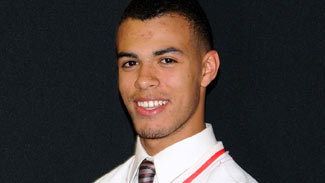
Darnell Nurse
5) Carolina Hurricanes: Darnell Nurse (D, OHL, Sault Ste. Marie) = I could see Jim Rutherford trading this pick, perhaps to the New York Rangers to complete the Staal family tree by acquiring Marc Staal, a steady shutdown defenceman to anchor the blue-line alongside more offensive talents such as Justin Faulk (second rounder in 2010) and Ryan Murphy (first rounder in 2011). Failing that, I could see the ’Canes picking a Staal-type defender in Darnell Nurse over a handful of forward options at No. 5.

Elias Lindholm
6) Calgary Flames: Elias Lindholm (C, Sweden, Brynas) = This pick will be especially important for the future of the Flames and general manager Jay Feaster needs to make the most of it to kick-start Calgary’s rebuild. I fully expect him to take a forward here and I think he’ll opt for Lindholm as a future linemate for Sven Baertschi (first rounder in 2011).
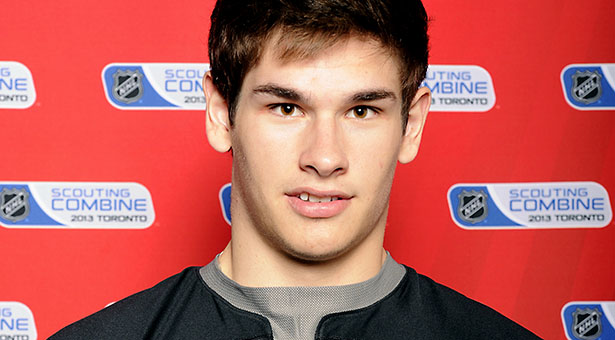
Sean Monahan
7) Edmonton Oilers: Sean Monahan (C, OHL, Ottawa) = The Oilers are apparently entertaining trade options — to move up or down — but if they stand pat, I expect new general manager Craig MacTavish to announce Monahan’s name if he’s available at No. 7. He is a bigger, grittier version of Sam Gagner (sixth overall in 2007), who may be better suited to playing wing going forward anyway.
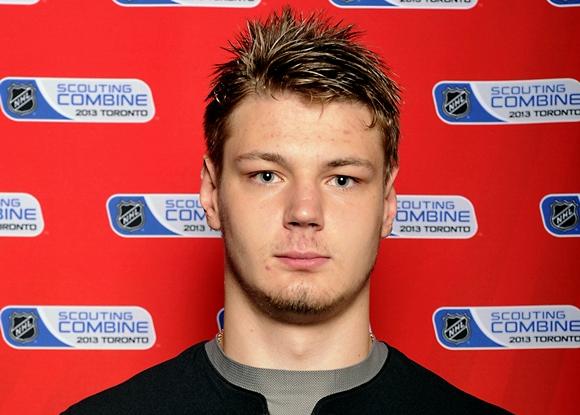
Valeri Nichushkin
8) Buffalo Sabres: Valeri Nichushkin (LW, Russia, Chelijabinsk) = Buffalo benefitted from Grigorenko’s fall last year and I don’t think Darcy Regier will shy away from picking another Russian in Nichushkin, who is likely the best talent left on the board here. Buffalo’s offence needs replenishing with Jason Pominville traded to Minnesota and Thomas Vanek also rumoured to be on the block, so I see Nichushkin fitting in well with the likes of Cody Hodgson, Grigorenko and Joel Armia (first rounder in 2011) in the future.
Bo Horvat
9) New Jersey Devils: Bo Horvat (C/LW, OHL, London) = I wouldn’t necessarily say there’s a drop-off in talent after the top 8, but I think this is where the draft really starts to get intriguing as individual team’s scouting lists could have 20 different players ranked at No. 9. In other words, there’s no consensus next-best prospect here, but I think Horvat’s performance at the Memorial Cup and throughout the OHL playoffs could elevate him into the top 10. Horvat is close to NHL-ready and the Devils could use a player capable of stepping into the lineup and contributing next season, considering Lou Lamoriello must forfeit the franchise’s 2014 first-round pick as penalty for Ilya Kovalchuk’s contract.
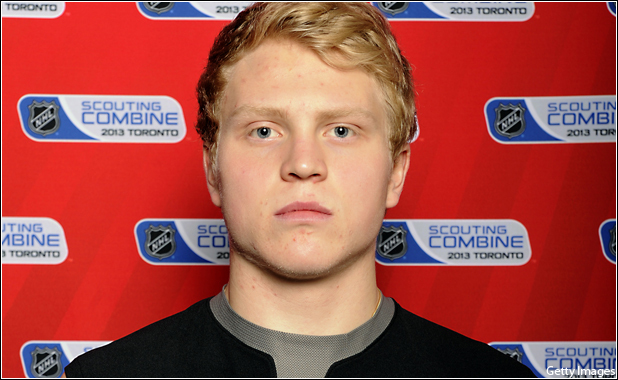
Hunter Shinkaruk
10) Dallas Stars: Hunter Shinkaruk (C/RW, WHL, Medicine Hat) = The Stars could use another coveted defence prospect and there’s a couple still available in this mock, but new owner Tom Gaglardi is a Western Canadian boy and I think he’ll push for that type of team make-up, with Shinkaruk perhaps the first step in that direction. Shinkaruk is blazing fast and has some sniping ability, not unlike former Medicine Hat teammate Emerson Etem, an Anaheim first-rounder in 2010.
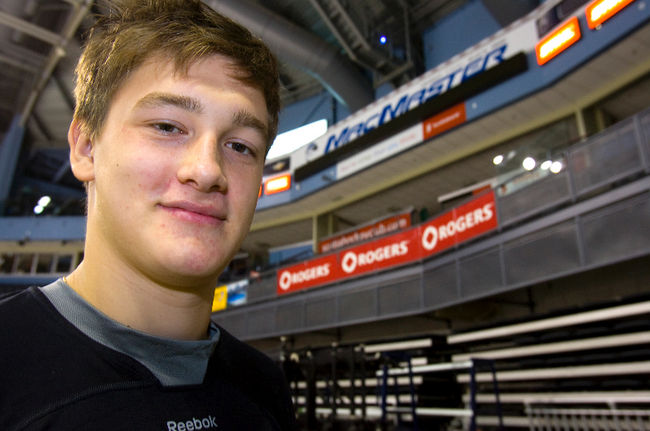
Nikita Zadorov
11) Philadelphia Flyers: Nikita Zadorov (D, OHL, London) = Speaking of teams in need of defence prospects, the Flyers will likely be thrilled to see Zadorov still available, along with Finland’s Rasmus Ristolainen. I think Paul Holmgren will pick one of those two, with the edge to Zadorov.

Curtis Lazar
12) Phoenix Coyotes: Curtis Lazar (C, WHL, Edmonton) = The Coyotes are pretty set on the back end but could use more depth up front. I think Don Maloney will opt for Lazar over Max Domi, given Lazar’s already established chemistry with Phoenix’s 2012 first-rounder, Henrik Samuelsson. The Edmonton linemates will try to translate their junior success to the NHL in the desert or elsewhere should the franchise relocate before they make the jump.

Max Domi
13) Winnipeg Jets: Max Domi (C/LW, OHL, London) = This seems like another natural fit, with Domi’s dad Tie having played for the old Jets and Winnipeg in need of future offensive catalysts to pair with Mark Scheifele (first rounder in 2011). Alexander Burmistrov (first rounder in 2010) has asked to be traded and the addition of Domi could offset that eventual loss should the request be granted.
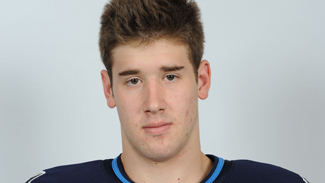
Frederick Gauthier
14) Columbus Blue Jackets: Frederik Gauthier (C, QMJHL, Rimouski) = This pick is the opposite from the last two in that nobody really jumps out at me here. New Columbus GM Jarmo Kekalainen obviously has Finnish roots and is likely quite familiar with Ristolainen, who is a very viable option at No. 14, but the Blue Jackets are already strong on defence — or stronger than they are at forward. I’m not convinced Kekalainen will go with a European, but it wouldn’t surprise me, either. That said, I could see Columbus picking Gauthier, a late bloomer with size and skill who reminds some of Benoit Pouliot (fourth overall in 2005).
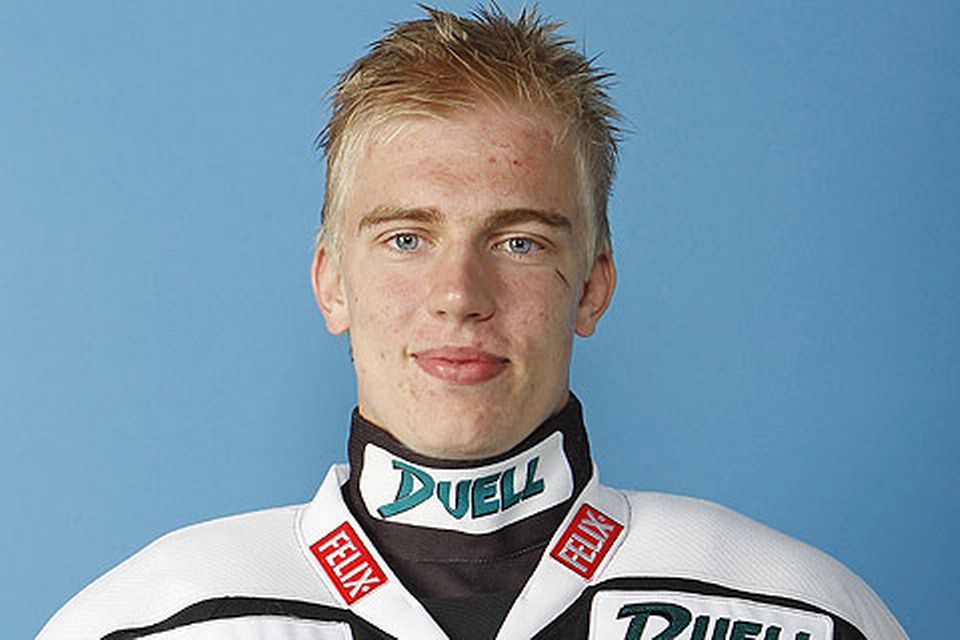
Rasmus Ristolainen
15) New York Islanders: Rasmus Ristolainen (D, Finland, Turku) = The Islanders have good prospect depth and will likely go with the best player available approach here. In my estimation, that would be Ristolainen, a good complement to last year’s first rounder, Griffin Reinhart (fourth overall). They are both big and blonde and could be quite the tower of power on Long Island. Another option here that might make sense is the top-rated goaltender, Zachary Fucale, with Evgeni Nabokov and-or Tim Thomas on the downside of their careers and Kevin Poulin and-or Anders Nilsson not necessarily looking like heir apparents. But the Islanders are still sporting that Rick DiPietro noose, so they may opt against picking another netminder in the first round for the sake of their fan base’s sanity.

Zachary Fucale
16) Buffalo Sabres (from Minnesota): Zachary Fucale (G, QMJHL, Halifax) = With their second pick of the first round, I can see the Sabres gambling on Fucale, although I don’t think it’s that much of a gamble. I think he’ll be a poor man’s Marc-Andre Fleury — not the Fleury that sieved out in the last two playoffs, but the usually stellar, incredibly athletic version. Buffalo is rumoured to be shopping longtime netminder Ryan Miller, which would leave Jhonas Enroth (second rounder in 2006) and Matt Hackett (third rounder in 2009) as the future between the pipes. A little extra competition certainly wouldn’t hurt in my estimation.

Alexander Wennberg
17) Ottawa Senators: Alexander Wennberg (C, Sweden, Djurgardens) = The Senators have always had success with Swedish prospects and players, so I could see them going back to that well again at this year’s draft. According to my mock thus far, there will be a few good Swedes left on the board here, but I think Wennberg is the best of the bunch and a nice addition to Ottawa’s forward ranks.
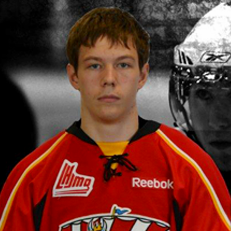
Valentin Zykov
18) Detroit Red Wings: Valentin Zykov (RW, QMJHL, Baie-Comeau) = Of course, the Red Wings would get another steal of a European forward in this year’s draft — why wouldn’t they? Zykov burst onto the Canadian scene, scoring 40 goals and earning CHL rookie of the year honours. He’s no longer under the radar, but I can totally see Detroit taking him here and turning him into a top-10 talent from this draft class in hindsight.

Ryan Pulock
19) Columbus Blue Jackets (from N.Y. Rangers): Ryan Pulock (D, WHL, Brandon) = Again, Columbus is in a strange spot here, with a couple European talents left that might catch Kekalainen’s eye, but at this point, and after already selecting a forward, I think Pulock is the best player available. He has arguably the best (or hardest) shot of anybody in this draft class and could make a great future partner for 2012 first-rounder, Ryan Murray (second overall).

Andre Burakowsky
20) San Jose Sharks: Andre Burakowsky (LW, Sweden, Malmo) = I have no clue what the Sharks will do with this pick, but Burakowsky’s name leapt out at me for some reason, so call this selection a gut feeling. If San Jose wanted defence instead, don’t be surprised if they go with the hulking Samuel Morin here.

Anthony Mantha
21) Toronto Maple Leafs: Anthony Mantha (LW, QMJHL, Val d’Or) = The Leafs have long been attracted to big forwards and Dave Nonis is still an understudy to Brian Burke, so I could totally see him taking Mantha here. Especially considering how well James van Riemsdyk played this season, perhaps Toronto’s scouting staff projects Mantha to have a somewhat similar trajectory.
Josh Morrissey
22) Calgary Flames (from St. Louis): Josh Morrissey (D, WHL, Prince Albert) = With their second pick of the first round and after going overseas for their first selection, the Flames take the hometown kid at No. 22. Morrissey is a Calgary product and one of several puck-moving defencemen from the WHL expected to be selected in this range, along with Shea Theodore, Mirco Mueller and Madison Bowey. I full expect Calgary to take one of those four blue-liners but most likely the local if he’s available.

Samuel Morin
23) Washington Capitals: Samuel Morin (D, QMJHL, Rimouski) = Washington went with size up front in last year’s first-round pick of Tom Wilson and I can see the Capitals going with size on the back end this time around by taking the 6-foot-7 Morin. Then again, Washington might go in a different direction with another former first-rounder cut from the same cloth, 6-foot-6 Jeff Schultz (27th overall in 2004), requesting a trade this spring after struggling to secure a roster spot.
Shea Theodore
24) Vancouver Canucks: Shea Theodore (D, WHL, Seattle) = I have a feeling the Canucks will also tap into that WHL defence group with their pick and Theodore boasts good size and skating ability with offensive upside. Mueller and Bowey are also options here.
Michael McCarron
25) Montreal Canadiens: Michael McCarron (RW, USA U-18) = The Canadiens could use some more size up front to complement Alex Galchenyuk and Brendan Gallagher, and McCarron certainly offers that at 6-foot-5, 228 pounds. Despite his stature, he’s likely a few years away from making an impact in the NHL, so perhaps a long-term replacement for another former first-rounder in Max Pacioretty (22nd in 2007).

Kerby Rychel
26) Anaheim Ducks: Kerby Rychel (LW, OHL, Windsor) = Rychel is one of those wild-cards who could go as high as 15 or as low as 45, but I think he’s a good fit for the Ducks. He might never be a big scorer at the next level, but you have to think he’d look right at home on an energy line with Devante Smith-Pelly.
Robert Hagg
27) Columbus Blue Jackets (from Los Angeles): Robert Hagg (D, Sweden, Modo) = My mind is made up that Columbus will be to blame for throwing my mock draft to the wolves as once again I’m stumped as to what the Blue Jackets do here. I can’t see Kekalainen making three first-round picks without a single European, but my research also tells me it is unlikely Columbus will take two defencemen in the first round with that position being an organizational strength. Still, for some reason, I see Hagg to the Blue Jackets, so I guess we will all have to wait and see.
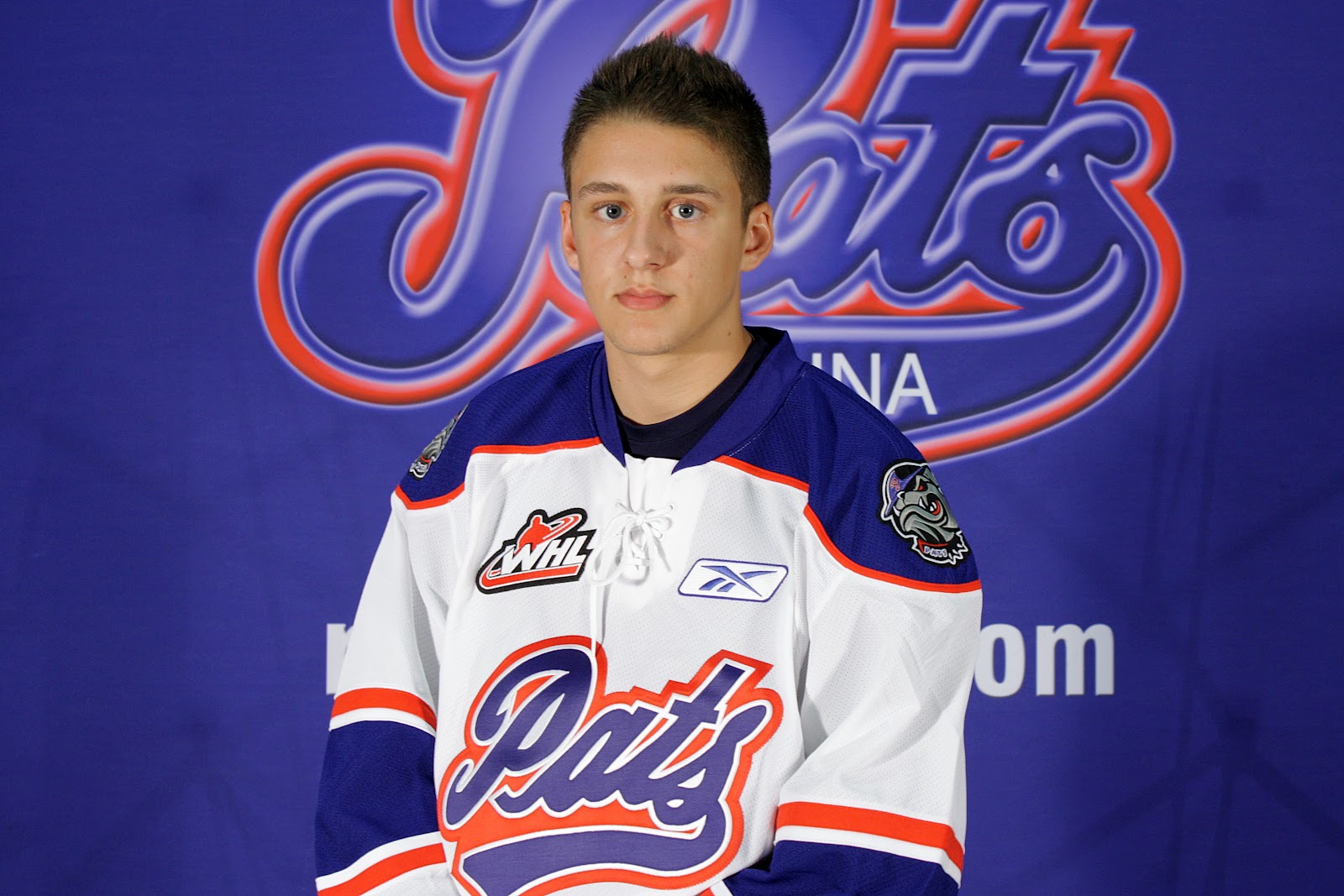
Morgan Klimchuk
28) Calgary Flames (from Pittsburgh): Morgan Klimchuk (C/LW, WHL, Regina) = Meanwhile, the Flames come across as more predictable to me (maybe that’s just me), and I think Klimchuk would round out an awfully good first round for Calgary following the selections of Lindholm and Morrissey. Klimchuk is no Jarome Iginla — for whom this pick was acquired — but he is a shoot-first scorer with a skill-set that should work well at the next level, potentially alongside Lindholm and Baertschi.
Mirco Mueller
29) Dallas Stars (from Boston): Mirco Mueller (D, WHL, Everett) = Mueller made a lot of strides in Everett this season in the absence of last year’s second overall selection, Ryan Murray (shoulder injury). Lots of teams have apparently taken a liking to Mueller and I expect Dallas to be among them, with Gaglardi again paying extra close attention to the Dub.

Steve Santini
30) Chicago Blackhawks: Steve Santini (D, USA U-18) = More than happy to pick last, Stan Bowman is still going to announce a quality prospect’s name at No. 30. It could any number of players at any position, but I have a feeling the Blackhawks will go with a defenceman here and Santini offers a pretty complete package.
Second Round
Nicolas Petan
31) Florida Panthers: Nicolas Petan (C, WHL, Portland) = With Jones already sitting at their draft table, Tallon returns to the podium with the goal of adding another key piece to Florida’s puzzle. He finds that in Petan, who put up a lot of points as part of Portland’s potent offence alongside Jones. Petan is on the small side, but he’s a competitor that could, in time, replace the presence of now unrestricted free agent and former first-round pick Stephen Weiss (4th overall in 2001).

Madison Bowey
32) Colorado Avalanche: Madison Bowey (D, WHL, Kelowna) = The Avs go the opposite route, getting in on the run of defencemen and possibly getting the best of the bunch. Bowey is a potential steal at this point and could be off the board much sooner after an impressive showing at the under-18 tournament, including a goal in the championship game to help Canada capture gold. Not to mention the Avs already landed a pretty promising defenceman out of Kelowna’s program in 2009 third-rounder Tyson Barrie. Further, the Rockets recently drafted the bantam-aged son of Avs defence coach/consultant Adam Foote, so add it all up and Bowey seems like a perfect fit here. However, another option could be Adam Erne, who played for Roy’s Quebec Remparts last season.
Adam Erne
33) Tampa Bay Lightning: Adam Erne (LW, QMJHL, Quebec) = The Lightning already have a small forward in Drouin, but although Erne is only 6-foot, he is solidly built at 210 pounds. Erne is a bit of a faller at this point, so Yzerman considers him the best player available.

Laurent Dauphin
34) Montreal Canadiens (from Nashville): Laurent Dauphin (C, QMJHL, Chicoutimi) = A francophone point-producer seems like the perfect fit here for Montreal, especially a versatile one like Dauphin who earned a lot of praise for his efforts in winning U-18 gold. Montreal is still waiting on former first-rounder Louis Leblanc (18th in 2009), but I don’t think Marc Bergevin will overlook Dauphin with this pick.
Jacob De La Rose
35) Carolina Hurricanes: Jacob De La Rose (C, Sweden, Leksand) = The Hurricanes went with a big defenceman in the first round and follow up with a big forward in the second round. Although De La Rose may be somewhat similar to another recent Carolina second-rounder in Victor Rask (42nd in 2011), that pick seems to be panning out, so I could see Rutherford looking for a repeat.
Jordan Subban
36) Montreal Canadiens (from Calgary): Jordan Subban (D, OHL, Belleville) = Speaking of natural fits for the Canadiens, with this already their third pick of the draft, the Habs can afford to use it on Norris Trophy winner P.K. Subban’s little brother, a fellow defenceman. It makes sense and although Subban is considered one of the draft’s biggest risers, he should still be on the board at this spot.

Ryan Hartman
37) Edmonton Oilers: Ryan Hartman (RW, OHL, Plymouth) = Hartman plays much bigger than he is (5-foot-11, 185 pounds), and he possesses the jam that Edmonton is coveting to complement all of its skilled forwards. If the Oilers can come away with Monahan and Hartman, they could have two-thirds of a future checking line, something they sorely lacked in recent years. Monahan will likely play a scoring-shutdown role better than Shawn Horcoff in his prime and Hartman could develop into a more physical, less offensive Ryan Smyth.
Ian McCoshen
38) Buffalo Sabres: Ian McCoshen (D, USHL, Waterloo) = The Sabres are having a good draft already at this point with a forward in Nichushkin and a goaltender in Fucale, so they opt for a defenceman here. At 6-foot-2, 207 pounds, McCoshen offers a lot to like and is perhaps overshadowed or lost in the shuffle among a strong crop of blue-liners this year.

Chris Bigras
39) New Jersey Devils: Chris Bigras (D, OHL, Owen Sound) = Speaking of lost in that defence shuffle, Bigras is a steady blue-liner that does almost everything good but nothing great. The Devils took a similar defender in last year’s second round, selecting Damon Severson at No. 60, but Bigras may be too good to pass up here.
William Carrier
40) Dallas Stars: William Carrier (LW, QMJHL, Cape Breton) = The Stars might have wanted to go defence with this pick, but most the top tier blue-liners are now off the board, so they gladly select a 6-foot-2 potential power forward as a consolation prize.
Justin Bailey
41) Philadelphia Flyers: Justin Bailey (RW, OHL, Kitchener) = The Flyers have always had a thing for big forwards and Bailey is 6-foot-3, so I can’t imagine Holmgren not liking his potential here. Wayne Simmonds is a 6-foot-2 former second-rounder (61st in 2007), so that could be a decent comparable and not just because both are African-American.
Eric Comrie
42) Phoenix Coyotes: Eric Comrie (G, WHL, Tri-City) = The Coyotes could be losing Mike Smith to free agency this summer and their goaltending pipeline isn’t exactly stocked with prospects, though Phoenix did use a recent first-rounder on Mark Visentin (27th in 2010). He could use some competition and Comrie is as competitive as they come, so a homegrown netminder would certainly bode well for the Coyotes.
Eric Roy
43) Winnipeg Jets: Eric Roy (D, WHL, Brandon) = The Jets seem to like character kids in the second round, selecting gritty forward Lukas Sutter at No. 39 last year, so I could see that trend continuing with Roy. Winnipeg’s scouts likely saw plenty of Roy this winter and he scored 17 goals — three more than Pulock — so this could be a solid addition in terms of defensive depth.

Bogdan Yakimov
44) Columbus Blue Jackets: Bogdan Yakimov (C, Russia, Nizhnekamsk) = Ughh, Columbus again. After picking two defencemen and a big forward in the first round, Kekalainen could very well target a boom-or-bust project with this pick. Yakimov would fit that bill as a 6-foot-5 centre who could develop into a Nik Antropov type.
J.T. Compher
45) Anaheim Ducks (from N.Y. Islanders): J.T. Compher (LW, USA U-18) = Call it a gut feeling, but I think Compher is destined to be a Duck with this pick. Anaheim went with a similar player in last year’s second round, selecting Nicolas Kerdiles at No. 36, and I think that tandem could work well together going forward.
Juuse Saros
46) Minnesota Wild: Juuse Saros (G, Finland, HPK) = The Wild have been backstopped by a Finnish goaltender for the last seven seasons in Niklas Backstrom, who was set to become an unrestricted free agent this summer before signing a three-year extension earlier this week. Backstrom could serve as a quality mentor for Saros, who could, in turn, be a long-term solution and give Minnesota more options between the pipes beyond Josh Harding and Darcy Kuemper.
John Hayden
47) St. Louis Blues (from Ottawa): John Hayden (C, USA U-18) = Kind of like Compher in Anaheim, I just see Hayden in St. Louis for some reason. He reminds some of current Blues forward T.J. Oshie and others of Ryan Kesler, but Hayden has the physical toolbox to work with at 6-foot-2, 200 pounds. The Blues have good forward depth for the time being, so they could afford to wait and allow Hayden to properly develop.

Pavel Buchnevich
48) Detroit Red Wings: Pavel Buchnevich (LW, Russia, Cherepovets) = This is another pick that almost seems too obvious, given Detroit’s success with another Russian named Pavel (Datsyuk). Not to make that comparison as Buchnevich is a totally different player, but I could see the Red Wings trying to catch lightning in a bottle again here.
Emile Poirier
49) San Jose Sharks (from N.Y. Rangers): Emile Poirier (LW, QMJHL, Gatineau) = With three of the next 10 picks, I think the Sharks can afford to take a couple chances in the second round. That said, Poirier isn’t a huge risk as he’s decent-sized and put up a good number of points (32 goals, 70 points) this season, so he might more so fit the label of best player available here.
Oliver Bjorkstrand
50) San Jose Sharks: Oliver Bjorkstrand (LW, WHL, Portland) = Bjorkstrand, on the other hand, is a bit more of an enigma despite a stellar North American debut for the Winterhawks. Originally from Denmark, it’s difficult to decipher what Bjorkstrand will become, but the Sharks are intrigued by his potential.
Jason Dickinson
51) Toronto Maple Leafs: Jason Dickinson (C, OHL, Guelph) = This could be deemed a slightly safer pick for Toronto, with Nonis simply picking his best player available in Dickinson. It doesn’t hurt that he’s an Ontario boy, either.
Zach Nastasiuk
52) Buffalo Sabres (from St. Louis): Zach Nastasiuk (RW, OHL, Owen Sound) = The Sabres almost took an Owen Sound player with their last pick but settled on Ian McCoshen over Chris Bigras. This time, the Owen Sound prospect wins out, with Buffalo opting for an all-around forward in Nastasiuk.
Marko Dano
53) Washington Capitals: Marko Dano (C, Slovakia, Trencin) = As much as the Capitals like their size, they also like their skill and some flash. Dano represents the latter and could become an electrifying player if he pans out.
JC Lipon
54) Dallas Stars (from Vancouver): JC Lipon (C, WHL, Kamloops) = This might be a bit high for Lipon based on some scouting lists, but I think the Stars will roll the dice on the over-ager here. The Los Angeles Kings took Tanner Pearson to end last year’s first round and he didn’t disappoint in his first pro season, though he’s a bit bigger than Lipon. But again I think Dallas will begin to target WHL talents and Lipon is one of the better WHL forwards available this year.
Artturi Lehkonen
55) Montreal Canadiens: Artturi Lehkonen (LW, Finland, TPS) = I’d say the Canadiens are having a good draft at this point, getting most of their targets, so they decide to take a bit of a flyer here on a falling European in Lehkonen. His skill-set could be first-round calibre, but it’s hard to predict where Lehkonen will go, so I expect a team with multiple picks to take a chance on him if he starts sliding.
Tristan Jarry
56) Edmonton Oilers (from Anaheim): Tristan Jarry (G, WHL, Edmonton) = This seems to be a popular pick amongst Oilers fans and Edmonton has shown a tendency to pick Oil Kings in the past. The Oilers have a couple goaltending prospects in the pipeline (Olivier Roy and Tyler Bunz), but another couldn’t hurt, especially one developing in their own backyard.

Jimmy Lodge
57) Los Angeles Kings: Jimmy Lodge (C, OHL, Saginaw) = This is likely another case of best player available, with the Kings having above average prospect depth at all positions. Perhaps they would go with a goaltender here, having decided against signing former second-rounder Christopher Gibson (49th in 2011), but the best option left is likely Philippe Desrosiers.

Jan Kostalek
58) San Jose Sharks (from Pittsburgh): Jan Kostalek (D, QMJHL, Rimouski) = After adding three forwards, the Sharks go defence here and take who they see as the best blue-liner left in Kostalek. A product of the Czech Republic, Kostalek made the move to North America this past season and still has some developing to do, but the upside is worth this pick.
Adam Tambellini
59) Winnipeg Jets (compensatory): Adam Tambellini (LW, BCHL, Surrey) = Tambellini is a bit of a high-risk, high-reward project, but the Jets can afford that type of prospect here. He has good bloodlines, which Winnipeg will like, so I see this as another good fit, though Tambellini could be a surprise draft riser and be off the board well before this pick.
Dillon Heatherington
60) Boston Bruins: Dillon Heatherington (D, WHL, Swift Current) = The Bruins know all about the importance of a big, mean defenceman having been captained to a Stanley Cup championship by Zdeno Chara and coming within two wins of repeating that feat this spring. Not to compare Heatherington to Chara because there’s really no comparison there, other than the fact Heatherington has decent size at 6-foot-3 and plays a physical, defence-first style. This wouldn’t be a sexy pick, but it’s the kind of pick that helps put teams over the top when the going gets tough.
Philippe Desrosiers
61) Winnipeg Jets (from Chicago): Philippe Desrosiers (G, QMJHL, Rimouski) = Winnipeg is another franchise that could use a goaltending prospect and I fully expect the Jets to use one of their four picks in the opening two rounds to address that need. With two forwards (Domi, Tambellini) and a defenceman (Roy) already in their stable from this draft, the Jets can roll the dice on Desrosiers, who backstopped Canada to under-18 gold this spring. Then again, I wouldn’t be shocked to see Winnipeg use an earlier pick on one of Fucale, Comrie or Jarry, perhaps even Saros or Spencer Martin (OHL, Mississauga).

UFC on FOX 5: Henderson vs. Diaz

Negotiations have taken a positive turn towards ending the NHL lockout, but there will be no Hockey Night In Canada again this Saturday.
Craving a fix to fill that void? Look no further than Sportsnet, which will be airing UFC on FOX 5 — a stacked mixed martial arts card headlined by the lightweight (155-pound) title fight between champion Benson (Smooth) Henderson and top-ranked challenger Nate Diaz — live from KeyArena in Seattle, Wash.
This televised show, celebrating the one-year partnership between the UFC and FOX, rivals most recent pay-per-views for quality and quantity of talent. It features several highly anticipated scraps with title implications, plus others that promise to be crowd (and couch potato) pleasers.
The co-main event pits former light-heavyweight (205-pound) champion Mauricio (Shogun) Rua of Brazil against fast-rising contender Alexander (The Mauler) Gustafsson of Sweden in an international matchup.
Speaking of rising contenders, the third-to-last fight will showcase Canada’s Rory (Ares) MacDonald — often hailed the future of the welterweight (170-pound) division — against B.J. (The Prodigy) Penn, a living legend who has held belts in two divisions (welterweight and lightweight) and is returning from a brief retirement. To many hardcore MMA fans, that past-versus-future theme holds the most intrigue of any matchup, not to mention the bad blood that’s brewed between the combatants.
The main card will likely start off with a bang as Mike (Quick) Swick squares off against Matt (The Immortal) Brown in a battle of welterweight strikers — or rather sluggers. The preliminary card, also to be shown on Sportsnet, has its share of barnburners (on paper) that should set the tone for an exciting night of fights.
Personally, it’s been more than two months since my last blog entry and UFC predictions, so while I plan on posting with more regularity going forward, be forewarned this submission could show signs of ring rust.
Then again, Georges St-Pierre showed no ill effects from his 18-month layoff in handily dispatching Carlos Condit a couple weeks back, successfully defending his welterweight title for the seventh time.
So let’s see if I can perhaps pick up where I left off as well, starting with the main event and working my way down.

Benson Henderson vs. Nate Diaz
The lighter weight classes never seem to disappoint and I fully expect this pairing to put on another fun fight — granted they’ll likely have a tough act to follow with the fireworks expected beforehand.
Henderson is bigger and more powerful, but Diaz is dangerous in all aspects as evidenced by three straight finishes — all submissions — during his current winning streak since dropping to lightweight following a lopsided decision loss to MacDonald at welterweight.
Henderson (17-2), currently on a five-fight winning streak, used his size advantage to score consecutive decision victories over former kingpin Frankie Edgar, dethroning the undersized champ and then thwarting his efforts again in a title defence this past August. Diaz (16-7) most recently choked out Jim Miller in May to secure No. 1-contender status and set the stage for Saturday’s showdown.
My take: I see Henderson controlling Diaz with his wrestling and outmuscling him, basically imposing his will and better executing his game plan en route to defending his belt. I don’t think Diaz’s punches-in-bunches will faze Henderson, so his only chance is to lock up a submission by catching hold of his opponent’s limbs. Henderson is a smart, technical fighter, so I’m picking him by unanimous decision.
Mauricio Rua vs. Alexander Gustafsson
I don’t know what to expect from these two. It’s a step up in competition for Gustafsson, but I think he’s ready for this kind of test. Whether he’s ready to pass it and inch closer to challenging Jon (Bones) Jones, that remains to be seen.
Rua (22-4-1) has been in a lot of wars over the years and he’s about as battle-tested (and proven) as they come. He’s been fighting professionally for a decade and, at 31 years old, might be in the midst of his final run toward reclaiming the UFC belt he lost to Jones last March. Since then, Rua has won two of his last three, the third result being a draw with Dan Henderson in the 2011 Fight of the Year.
Gustafsson (14-1), meanwhile, is on the upswing. He’s won five straight since his only loss to Phil Davis in April 2010, but he hasn’t been in the Octagon with the same level of fighters as Rua. For the most part, Gustafsson has been facing (and beating) middle-of-the-pack, gate-keeper types such as Matt Hamill, Vladimir Matyushenko and, most recently in April, Thiago Silva via decision.
My take: It’s time to see what Gustafsson is made of and I’m honestly torn over how he’ll handle this opportunity. By all accounts, he’s confident and determined to succeed, yet I can’t help but think he could be in over his head against Rua. Gustafsson is tall and lanky, somewhat similar to Jones in body type, but Rua is a powerhouse and devastating striker who always goes for the kill. I think Rua will add another victim to his resumé by night’s end, via second-round TKO.
B.J. Penn vs. Rory MacDonald
MacDonald picked this fight and now he’s got it. Delayed from September’s Toronto card until Saturday in Seattle due to MacDonald suffering a severe cut over his eye during training camp, both have been chomping at the bit to settle this score and prove themselves.
Obviously Penn (16-8-2) has little to prove in the grand scheme, with his legacy already cemented as a pioneer and one of the sports’ all-time best pound-for-pound fighters. But Penn is still only 33 years old and, despite losing three of his last five fights and settling for a draw in another, he’s out to silence his critics and prove he’s not “washed up.” A driven and dedicated Penn is always dangerous — and downright scary — for any opponent.
The 23-year-old MacDonald (13-1) won’t be intimidated. In fact, he’s been taking an intimidator approach in the build-up, threatening to “smash” and “destroy” Penn — punching his ticket back to pasture, while propelling himself into a household name and perhaps into the title picture.
MacDonald, formerly a Kelowna resident who now trains out of Montreal’s famed Tristar gym, has gone on the record as refusing to fight teammate St-Pierre, who echoes that sentiment. A couple more MacDonald wins and one of them will likely have to move to middleweight to avoid that clash.
First things first, MacDonald will have his hands full with Penn. Once known as The Waterboy, MacDonald (4-1 in UFC) is constantly maturing and developing into a force to be reckoned with. He’s won three straight since his only loss to Condit in June 2010, a fight MacDonald was winning through two of three rounds.
My take: Penn is a prickly opponent and offers more challenges than Mike Pyle or Che Mills — MacDonald’s last two TKOed stepping stones. I wouldn’t necessarily say Penn is past his prime, but MacDonald is more certainly entering his prime and has the potential to not only defeat but finish Penn. Listening to MacDonald’s training partners, it sounds as though GSP’s protégé is not one to be messed with. MacDonald’s skill-set will speak for itself sooner than later and I’m expecting more of a statement win over Penn than either of St-Pierre’s past triumphs versus their Tristar nemesis. I’m predicting a star will officially be born, with MacDonald pounding out a first-round TKO.
Mike Swick vs. Matt Brown
Both fighters have compelling back stories, overcoming illness, injury and other personal demons in years past. They have got off life’s canvas more than once, and will now try to put each other down for the count.
UFC president Dana White and matchmaker Joe Silva are counting on these two to deliver a toe-to-toe display to open the main card — and, based on their track records, there’s no reason to expect anything less.
Swick (15-4, with 8 TKOs and 8 first-round finishes) and Brown (15-11, with 8 TKOs and 6 first-round stoppages) have only combined for 10 decisions in 45 career fights, so don’t expect this tilt to go the distance.
My take: With all due respect, I’m anticipating a glorified street fight with Swick and Brown meeting in the centre of the cage and trading blows until somebody hits the deck. Flip a coin as to who that will be, but my gut says Swick is left standing, emerging victorious by first-round TKO.
Preliminary Card
Yves Edwards vs. Jeremy Stephens = A lightweight fight that could also produce Saturday’s Knockout of the Night, or Fight of the Night if they are able to absorb each other’s punishment until the final horn. I’m picking Stephens (20-8) by TKO over the more experienced Edwards (41-18-1).
Raphael Assuncao vs. Mike Easton = A bantamweight (135-pound) fight that could go either way, but I’ve been extremely impressed with Easton (13-1, 3-0 in UFC), so I’ll go with him by decision over Assuncao (17-4, 2-1 in UFC).
Ramsey Nijem vs. Joe Proctor = A couple of TUF alumni squaring off in hopes of climbing the lightweight ladder, I’ll literally flip a coin on this one and go with Nijem (6-2, 2-1 in UFC) by decision over Proctor (9-1, 1-0 in UFC).
Daron Cruickshank vs. Henry Martinez = I actually like this lightweight fight and think it could be the sleeper on this card. Both guys are exciting and like to push the pace, so it should be entertaining one way or the other. For the sake of picking a winner, I’ll go with Cruickshank (11-2, 1-0 in UFC) by decision over Martinez (9-2, 1-1 in UFC).
Tim Means vs. Abel Trujillo = Another lightweight bout that I’m, admittedly, unfamiliar with the combatants and haven’t watched any of their previous fights. Trujillo (9-4) is making his UFC debut and that might be overwhelming against Means (18-3-1, 2-0 in UFC), who I will pick by decision again.
Dennis Siver vs. Nam Phan = This featherweight (145-pound) scrap really seems buried, or at least lost in the shuffle. Not too long ago, Siver (20-8) was considered a UFC contender at lightweight and Phan (18-10) has a penchant for action-packed fights. Expect a stand-up war, with Siver perhaps the more technical striker. I like Phan, but I’m picking Siver by third-round TKO.
Scott Jorgenson vs. John Albert = Both these bantamweights have lost two straight, albeit to their division’s top-end talents. I’ve always liked Jorgenson (13-6, 2-2 in UFC), he always brings it and there’s never a dull moment when his Mohawk enters the Octagon. He’ll have a sense of desperation for this one, despite his losses coming to interim champion Renan Barao and a Fight-of-the-Night performance against Eddie Wineland. I think that will fuel Jorgenson to a dominant decision victory over Albert (7-3, 1-2 in UFC).
 Larry Fisher